
Can You Drive Yellowstone in Winter? What’s Open + How To Get Around
Yellowstone in winter is not a drive-through park, so planning your trip gets a lot easier once you understand what’s actually open.
Here’s what it looks like to drive through Yellowstone in the winter, plus how to reach the rest of the park during the winter season.
Winter road access at a glance
Before we get into details, it helps to see winter access from a bird’s-eye view.
In winter, Yellowstone does not function as a loop. One road stays open to cars, and everything else switches to over-snow travel. Once you understand that layout, winter planning gets much simpler.
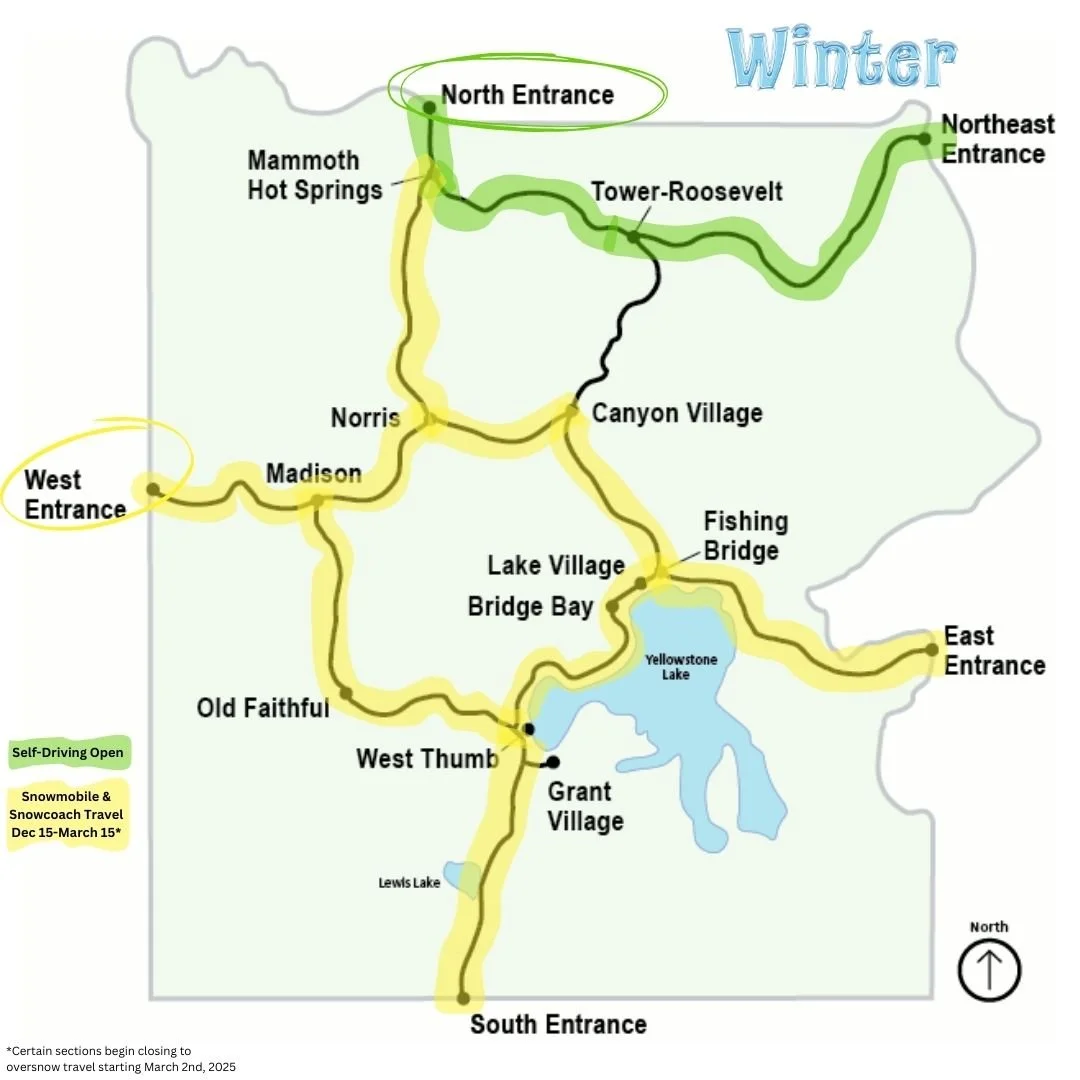
Below is a winter road access map showing the only road open to regular vehicles in winter, plus which areas and entrances are accessible by snowcoach or snowmobile only.
The only road open to cars
Yes, you can drive Yellowstone in winter, but only the road between Gardiner, MT, and Cooke City, MT. Everything else in the park is closed to regular vehicles and accessible only by snowcoach or snowmobile.
If you’re hoping to drive yourself in winter, you’ll want to base your trip around Yellowstone’s North Entrance in Gardiner, Montana. From there, you can drive to Mammoth Hot Springs, Tower Junction, and Lamar Valley, then continue out toward Cooke City at the Northeast Entrance.
This road is plowed daily and is open year-round, weather permitting. Snow and ice can still cause temporary closures, but the park does a great job keeping it moving. If conditions are good, you can do this entire stretch in one day. If conditions are less ideal, plan shorter drives and turn around when visibility drops. Winter driving here is slow, deliberate, and weather-dependent.
The good news is that this is where most winter wildlife watching occurs. Bison, wolves, foxes, elk, and coyotes all move through this corridor known as Yellowstone’s Northern Range. This stretch also gives you access to Mammoth Hot Springs, Undine Falls, and tons of snowshoeing and cross-country skiing trails.
If you plan to drive yourself in winter, the Northern Range is where you’ll be.
Everything else is closed to cars
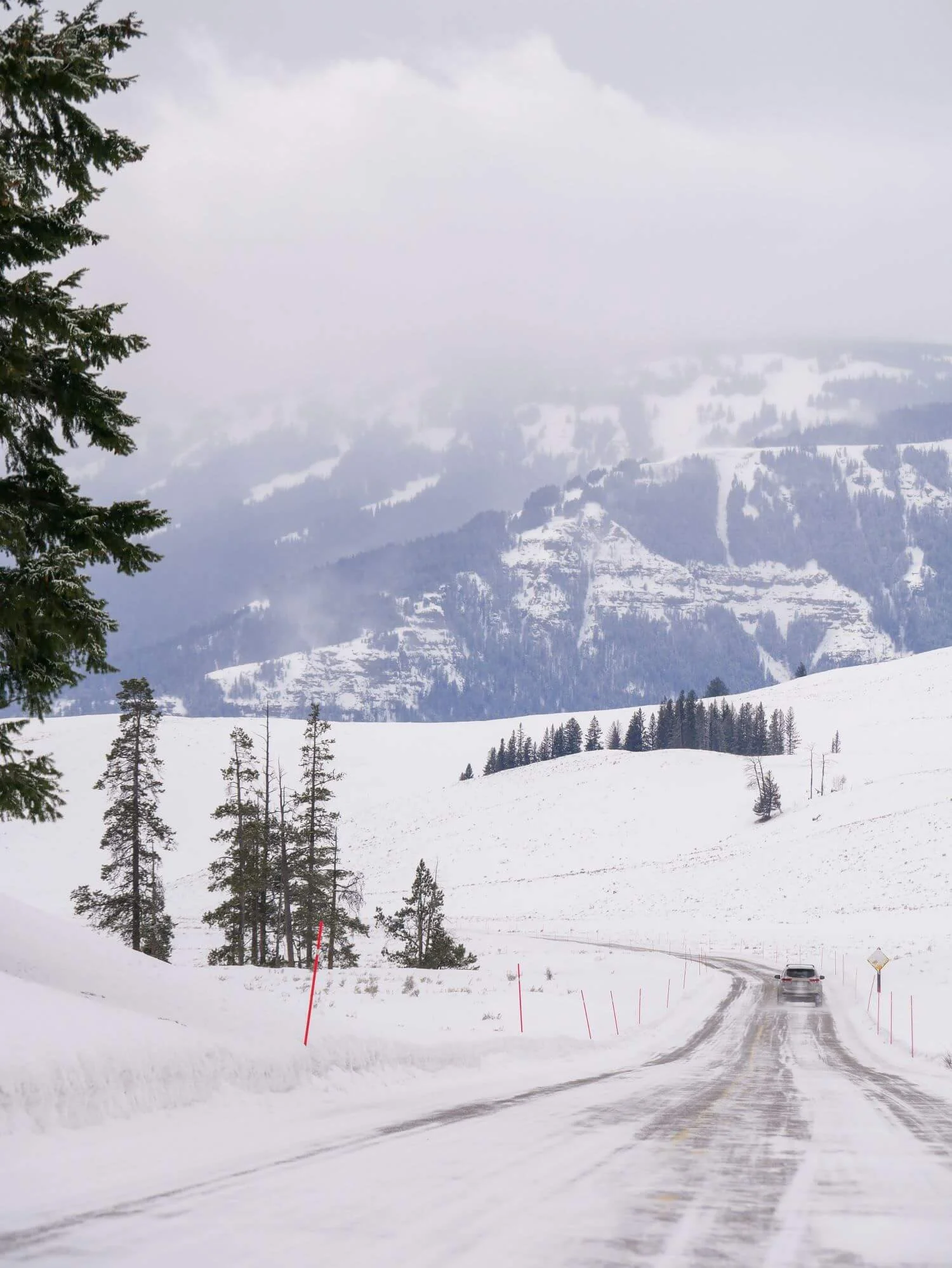
All other park roads are closed to normal vehicles in winter.
This means you cannot drive yourself to interior landmarks during winter months, including Old Faithful, Grand Prismatic Spring, Norris, Canyon Village, and the Grand Canyon of the Yellowstone.
These places are still there, of course. You just reach them differently!
Over-snow travel in Yellowstone (how to reach the interior)
Once Yellowstone’s winter season begins in mid-December, interior park roads open for over-snow travel. These vehicles travel on packed snow along the same roads cars use in summer.
There are three main ways to move beyond the plowed Northern Range in winter.
Snowcoach travel
Snowcoaches are large, heated vehicles with oversized snow tires and big windows. They move slowly and function like a guided sightseeing tour.
This is the most approachable option for most winter visitors, especially if it’s your first time in Yellowstone in winter.
Snowcoaches are how most people reach:
Old Faithful
Canyon Village
Norris Geyser Basin
You’ll stop along the way for wildlife sightings, thermal features, and photos. You’ll also have time on foot at major destinations. If you want to see Yellowstone in winter without worrying about driving or cold exposure, this is usually the best choice.
If seeing Old Faithful in winter is on your bucket list, we break down exactly how it works via snowcoach and what it’s like here.
Snowmobile travel
Snowmobiles offer a faster and more adventurous way to travel through Yellowstone in winter.
You’ll cover more ground quickly, but you’ll spend most of the day on the machine. Stops are shorter and more structured, and you’re exposed to the elements the entire time.
Snowmobile travel is best for people who:
Want a high-energy experience
Are comfortable riding for long stretches
Don’t mind cold temperatures and speed
Snowmobile routes can also reach places like Old Faithful and Canyon Village, depending on conditions. If you’re interested in snowmobiling through Yellowstone, here’s what the experience is like and how to know if it’s right for you.
Snowshoeing and cross-country skiing
Snowshoeing and cross-country skiing don’t replace snowcoach or snowmobile travel for long distances, but they’re an important part of winter access.
These options let you explore:
Trails beyond the Mammoth terraces
Quiet thermal areas
Closed roads near the Northern Range
Interior trails accessed from winter lodges
If you enjoy slower travel and quiet landscapes, this is one of the most immersive ways to experience Yellowstone in winter. Many visitors combine a snowcoach day with self-guided snowshoe or ski outings closer to where they’re staying.
Which option makes sense for you depends on where you’re staying, your comfort with winter conditions, and how much time you want on foot versus in transit.
Winter entrances and how to use them
Yellowstone has multiple entrances, but in winter, they do not operate the same way as in summer.
The North Entrance at Gardiner, MT, is the only entrance open to regular vehicles all winter. That’s why Gardiner is the hub for winter road trippers. It’s where we base ourselves when we visit Yellowstone in the winter and where our Cozy Yellowstone Compound, including the Yellowstone Christmas Cabin, is located.
The West Entrance in West Yellowstone, MT, is closed to cars but serves as a major snowcoach and snowmobile area. If you’re snowmobiling in Yellowstone, you’ll likely be staying here for at least part of your trip.
The South and East Entrances are also closed to private vehicles in winter. Limited snowcoach and snowmobile access is available from these entrances, but options are fewer than at the North or West Entrances.
As you plan lodging, the most important thing to know is that you can’t casually move between entrances in winter. For example, to get from West Yellowstone to Gardiner, you’ll drive back to Bozeman and over. Many people successfully split their trip between these two locations, but it’s helpful to know you won’t be driving through the park between stays.
Here’s more information on where to stay in Yellowstone in winter and a closer look at your four main lodging options.
What winter driving is actually like
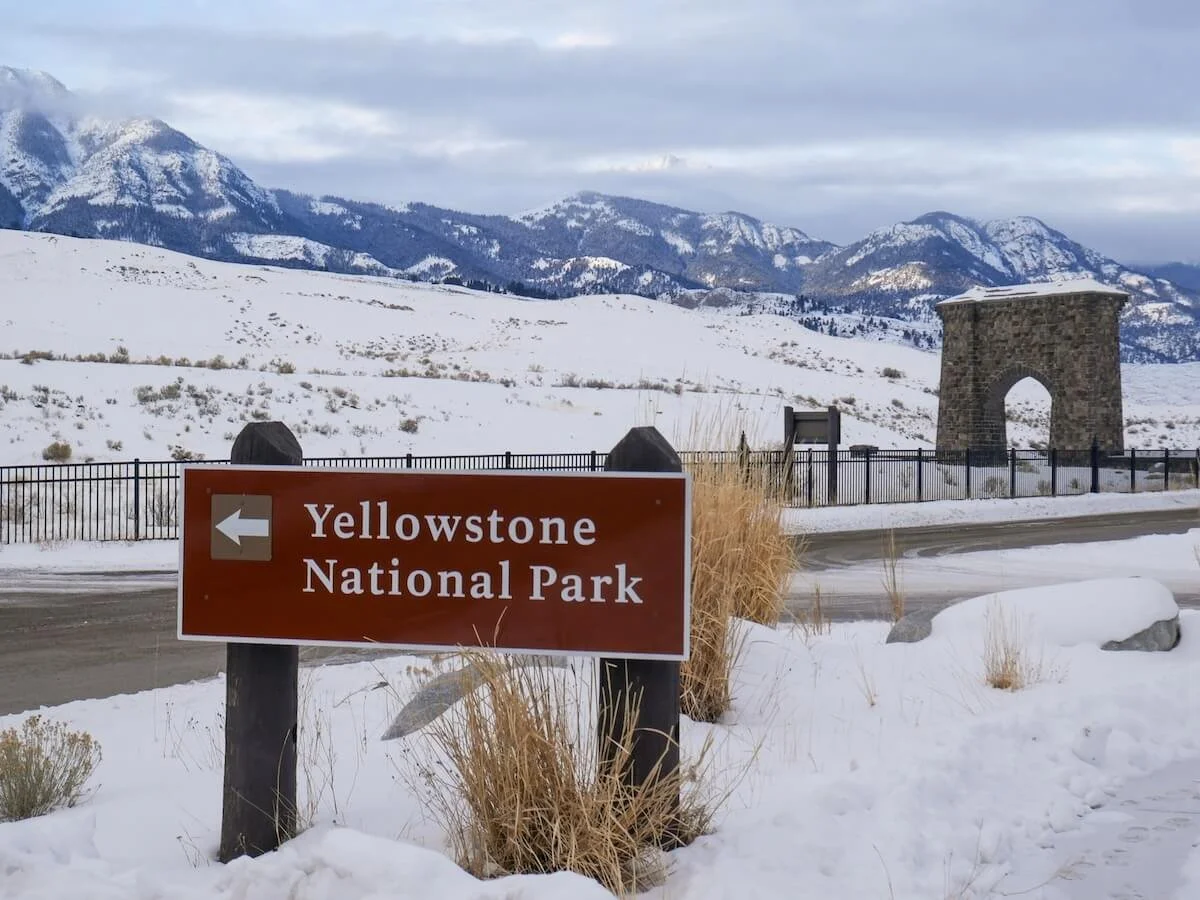
Winter driving in Yellowstone is not terrifying, but it’s not casual either. Snow and ice are common, visibility can change quickly, and wildlife frequently walks on the road.
The park does an excellent job plowing the Northern Range, but storms and high winds can still create temporary closures or delays. Always check the current road status before you head out.
Many rental car companies do not allow snow chains, so drive slowly, keep plenty of distance, and be prepared to adjust your plans if conditions change.
If you’re not comfortable driving on snow or ice, winter in Yellowstone is still possible. You just lean more heavily on snowcoach transportation and limit your self-driving days.
How to plan a winter trip
The biggest winter planning mistake is treating Yellowstone like a loop. In winter, you plan out-and-back days.
One day might be Mammoth and the Upper and Lower Terraces.
One day might be wildlife watching in Lamar Valley.
One day might be a snowcoach trip to Old Faithful.
One day might be a snowmobile tour to Canyon Village.
One day might be a rest day or a snowshoe and hot springs day outside the park.
In the summer, it’s possible to bounce between regions or even drive the entire Grand Loop. In the winter, you generally pick one highlight per day and build in buffer time for weather.
Keep planning your winter trip
To finish planning, you might also want:
Want a step-by-step plan for winter in Yellowstone? Our All-Seasons Yellowstone Travel Guide shows you what’s open, where to stay, and how to make the most of winter conditions.