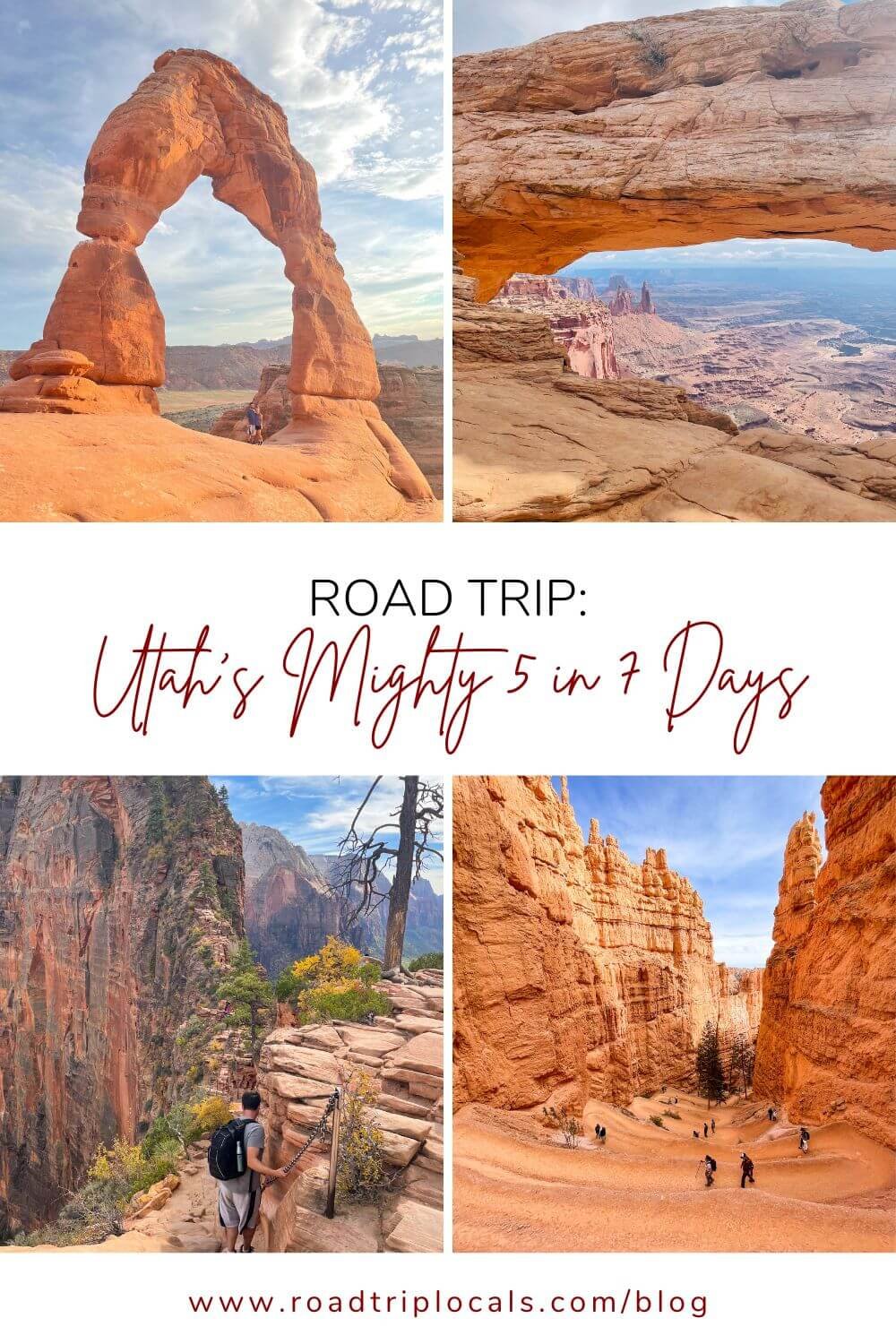
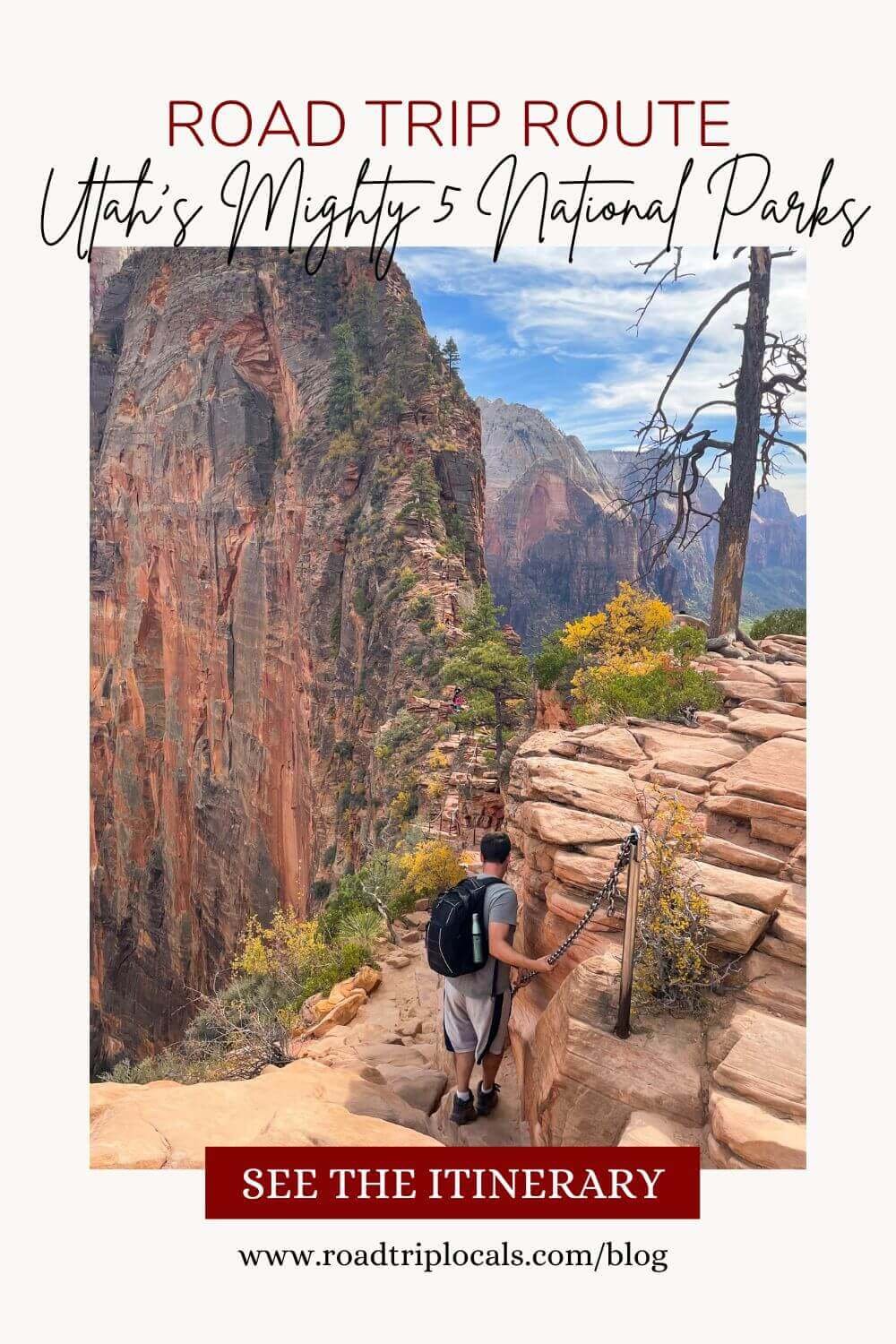
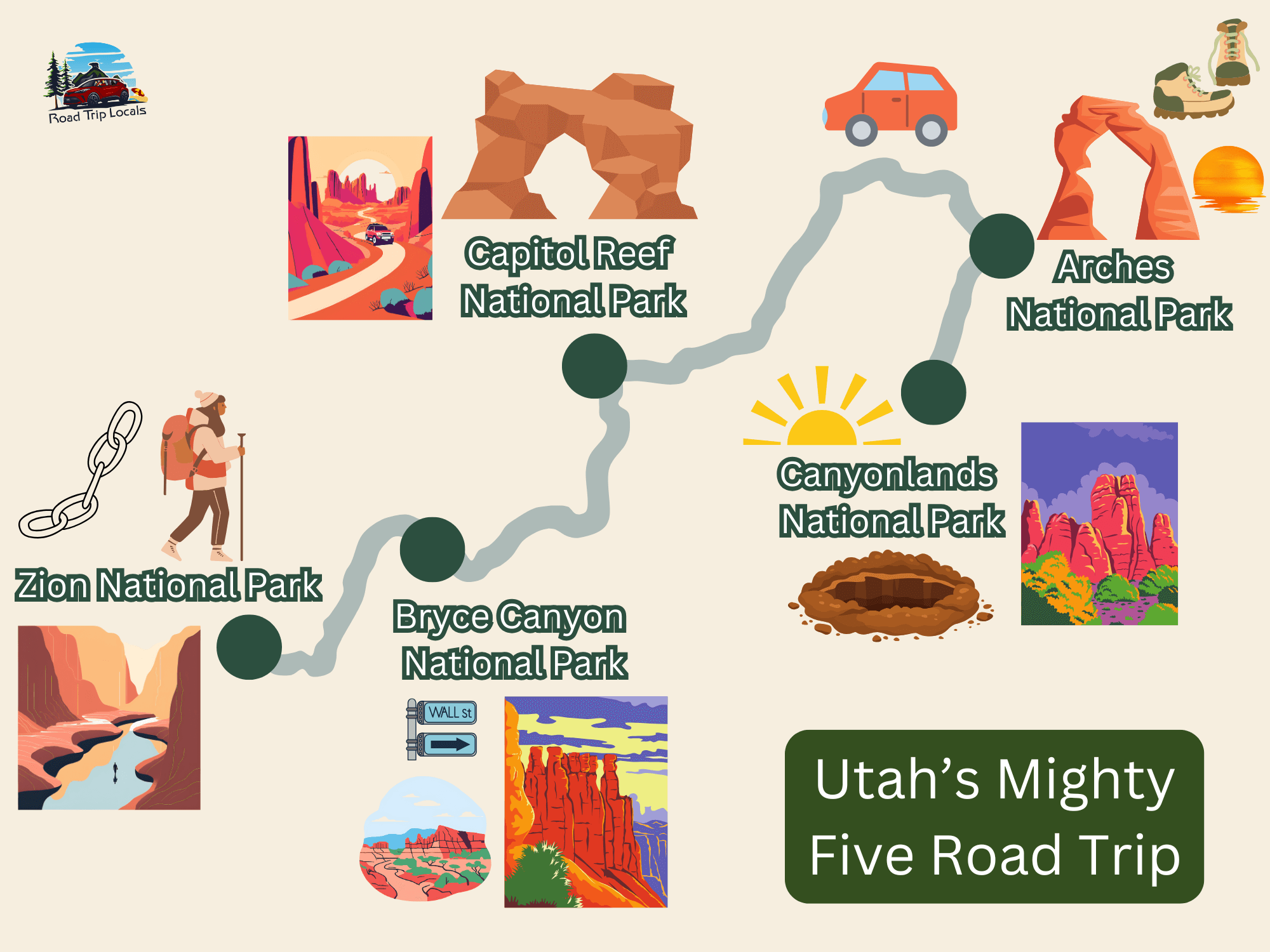
Utah’s “Mighty 5” represents the five national parks in Utah, including Arches, Capitol Reef, Canyonlands, Bryce Canyon, and Zion National Parks.
To see all five parks in 7 days, you’ll be driving… a LOT. That said, you’ll also see a lot. (A lot, a lot.) So if you’re okay with trading some long days for amazing views and one INCREDIBLE road trip, this one’s for you!
Here’s how to see Utah’s Mighty 5 National Parks in 7 days.
Table of Contents
Day 1: Moab, Arches National Park: Scenic Drive
On the first day of your 7-Day Mighty 5 Road Trip in Utah, travel to Arches National Park near Moab, Utah.
Arches Scenic Drive
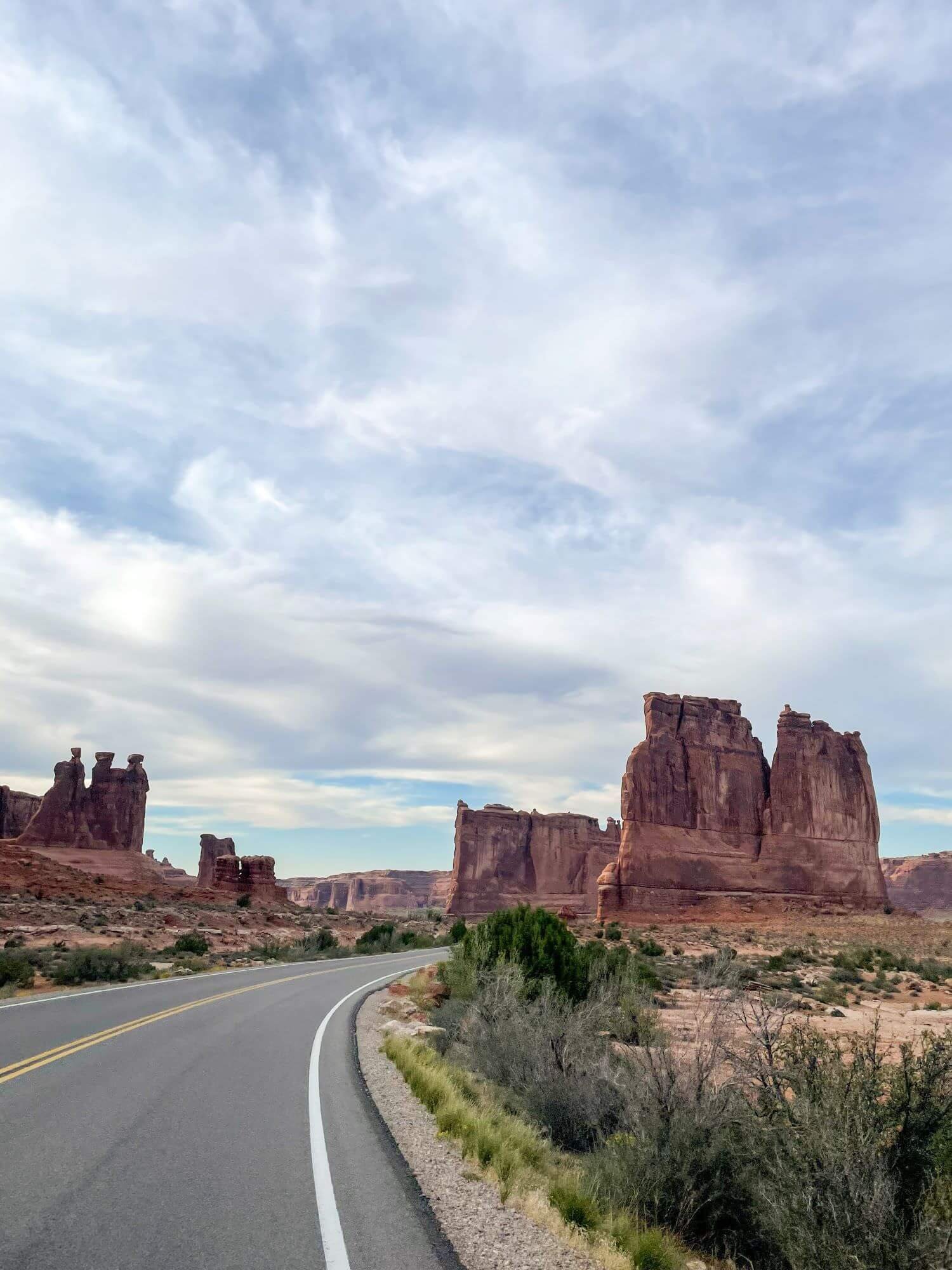
If you have time the day you arrive, start your sightseeing in Arches by driving Arches Scenic Drive (from the Visitor Center to the Devils Garden Campground). Stop at as many lookouts as possible to get a feel for the park and see many amazing arches!
If you have about 4 hours, drive the entire scenic drive.
If you need to pick and choose which stops you make, check out our suggestions below.
Hop out of your car at the Park Avenue Viewpoint to see the Courthouse Towers.
Drive to The Windows (and enjoy the view of Balanced Rock on your way). Park your car when you arrive at The Windows Section and walk the .7-mile trail to North Window, South Window, and Turret Arch. Walk the .5-mile trail to Double Arch.
If you’re not going to hike to Delicate Arch, then drive to the Delicate Arch Viewpoint. Otherwise, we highly recommend hiking to Delicate Arch at sunset if possible. (It’ll be crowded, but worth it. More on this below.) If you’re planning to hike to Delicate Arch, you can skip the Delicate Arch Viewpoint.
Drive the remainder of the scenic drive to the Devils Garden Campground, stopping to walk the .4-mile trail to Skyline Arch (this area is gorgeous at sunset).
Arches Scenic Drive

View of Double Arch- can you spot the person in this photo for size reference?

Skyline Arch during golden hour. Can you spot the people in Skyline Arch?
Day 2: Arches National Park: Devils Garden Trail, Delicate Arch
Today is a full day in Arches National Park!
If you didn’t have time to drive Arches Scenic Drive yesterday, you might want to start your day with that today. Otherwise, let’s get to hiking!
Our top recommendations for things to do in Arches National Park are to drive the scenic road, hike the Devils Garden Trail, and take a sunset hike to Delicate Arch.
Devils Garden Trail
The Devils Garden Trail is a 7.9-mile loop. This is the longest and probably most difficult trail in Arches National Park. This is especially true if you opt for the full trail, including the primitive side. For your effort, you’ll be rewarded with seeing the most arches of any trail in Arches: 7 total.
The Devils Garden Trail starts at the Devils Garden Campground, which is the furthest point on Arches Scenic Drive. You can choose to hike the entire 7.9-mile loop, or you can hike 1.8 miles to Landscape Arch (the longest arch in Arches), or you can hike 4.2 miles to Double O Arch (and on your way, pass some of the most gorgeous landscapes).
RTL Tip: Start early and hike counter-clockwise, so you hike the Primitive Trail first by staying right at the fork.
The Primitive Trail in Arches National Park is an incredible trail with amazing views but also difficult route finding, rock climbing, and steep slopes. This half of the Devils Garden Trail does not have traditional mile markers or clear paths to follow. Instead, you follow cairns. You may have to climb around, or wade through, a pool of water.
We loved exploring this part of Arches National Park, but we also got lost while hiking through it (and almost had to turn back and hike an additional 5 miles because of it).
So if you’re committed to the Primitive Trail, hike it first with plenty of daylight, energy, and water. If you’re not sure whether or not you want to hike The Primitive Trail, then hike clockwise (stay to the left at the fork) and see the majority of the arches first.
Since most of the arches along the Devils Garden Trail are on the marked section of the trail, you can see 6 arches without stepping foot on the Primitive side! After you enjoy this section of amazing arches, then you can decide whether you want to continue on to the Primitive Trail.
We most loved Partition Arch, Landscape Arch, and the scenery on the way to Double O Arch. We thought the overlook for Dark Angel was better than walking up to it, so if you do opt to hike the Primitive Trail, we recommend skipping the Dark Angel side trail.

Partition Arch

En route to Double O Arch

Primitive Trail
Delicate Arch at Sunset
Delicate Arch is one of the most popular trails in Arches National Park and one of the most iconic viewpoints. Hiking to Delicate Arch during golden hour is stunning!!
The Delicate Arch Trail is a 3-mile round trip hike that includes 480 ft of elevation gain. There is a bit of an uphill climb at the beginning of the hike, and you will have some exposure to heights (plus very little shade).
As one of the most popular things to see in Arches, this hike will likely be busy, but it’ll also be beautiful and, at times, feel like another world entirely!

Delicate Arch, Arches National Park
Bonus: Corona Arch
Have time for one more hike before you hop in the car and head to your next national park? Before you leave Moab, check out Corona Arch (about 20 minutes away).
Corona Arch rivals the arches of Arches National Park but is WAY less busy. And bonus: It’s a dog-friendly trail. There are a few steep sections along this trail and at least one spot (a ladder) that requires either an agile dog or someone who can carry the pup. But this is a truly amazing hike and a great trail when you need a break from national park crowds. Highly, highly, HIGHLY recommend it if you’ve got time!
Dog-friendly? Arches National Park is not dog-friendly. (Pets are not allowed on any hiking trails.) The Corona Arch Trail is dog-friendly.

Corona Arch, near Moab, UT
Day 3: Canyonlands
You’ll drive about 30 miles to national park number two on your Mighty 5 Road Trip: Canyonlands National Park.
While having dinner at a restaurant in Moab, we sat next to a gentleman who was on a motorcycle trip through the area. As we were swapping stories and suggestions, he told us Canyonlands was a must-see and actually his favorite park in the area.
While we can’t say it’s also our favorite, that’s only because The Mighty 5 includes 5 truly incredible parks. Canyonlands is gorgeous, unique, and much quieter than most others on this list. (Which is a pro in our books!)
The Island in The Sky District is the easiest and most popular area of Canyonlands to visit. That said, if you have a four-wheel-drive, high-clearance vehicle or time for backpacking or boating, you may also wish to explore The Needles, The Maze, or The River.
Since The Island in The Sky District is the closest to Moab, that’s what we recommend exploring along your 7-Day Mighty 5 Road Trip. Start with Canyonland’s Scenic Drive.
Note: Canyonlands get about half the annual visitors that Arches (and even Capitol Reef National Park) get. This is the park to visit if you’re looking for solitude!!
Canyonland’s Scenic Drive
You can drive the entire mesa top of the Island in the Sky District along this 34-mile roundtrip scenic drive. Stop at as many lookouts as you have time for.
If you need to pick and choose which stops you make, check out our suggestions below.
Drive, then hike to Mesa Arch (best at sunrise).
Drive, then hike to either the first or second overlook of the Upheaval Dome.
Drive to the Green River Overlook.
Drive to the Grand View Point.
Stop at the Shafer Trail Viewpoint of Shafer Road (on your way to exit the park).

Grand View Point Overlook

Shafer Trail Viewpoint of Shafer Road - this was my favorite overlook!
Mesa Arch at Sunrise
One of the most popular things to do in Canyonlands National Park is to hike to Mesa Arch at sunrise. This short .5-mile hike is relatively flat and leads to a beautiful view of an arch resting on a cliff.
Mesa Arch is most popular at sunrise, but if you can’t make it that early, that’s okay! The view of the La Sal Mountains from Mesa Arch is gorgeous any time of day. And while it’s also busy, the short trail means people come and go fairly quickly. Hang around for a bit, taking in the view, and you’re sure to get a beautiful shot.

Mesa Arch, Canyonlands
Upheaval Dome
You have two options to view The Upheaval Dome thanks to two different overlooks. You can hike .8 miles to the first Upheaval Dome overlook or 1.8 miles to both overlooks. From the first overlook, you’ll have a clear view into Upheaval Dome, plus you’ll get to read signs about the dome and what created it.
At the second overlook, you’ll get another view of Upheaval Dome and Upheaval Canyon. The picture below is from the second overlook, where you feel like you get to see directly into the dome.
What you’ll see at the overlooks on the Upheaval Dome trail is ultimately a mystery… was the two-mile-wide depression caused by a salt dome or a meteorite?
According to the national park service, recent findings support the dome having been created by a meteorite fracturing the rock on impact… but what do you think? Let us know in the comments below!

Bonus: Dead Horse State Park
After your visit to Canyonlands National Park, make a quick stop at Dead Horse State Park. This state park is only about 20 minutes from Canyonlands, so it’s a great, easy addition to your day. And while it’s gorgeous any time of day (we were visiting in the afternoon), Dead Horse State Park looks especially picturesque for sunset.
Dog-Friendly? Canyonlands National Park is not dog-friendly. Pets are allowed at Dead Horse State Park.
Day 4: Capitol Reef National Park
Next, make your way to Capitol Reef National Park (about a 2.5-hour drive from Canyonlands).
Three of the most popular things to do in Capitol Reef National Park include an 8-mile scenic drive of the Waterpocket Fold, a hike to Cassidy Arch, and the Hickman Natural Bridge Trail.
But because Capitol Reef is generally a less-visited park (when compared to the others in the Mighty 5), you won’t have to worry as much about navigating crowds throughout the day.
You can mix and match and start with whichever activity excites you most!
Natural Bridge Trail (Hickman Bridge)
One of the best things to do in Capitol Reef National Park is to hike the Hickman Natural Bridge Trail. As its name suggests, this 2-mile trail leads you to a 133-foot natural bridge.
In our opinion, the drive through Capitol Reef and the hike to Cassidy Arch are more scenic than the hike to Hickman Bridge. So if you only have time for one or two things, we suggest those activities instead.
That said, we did enjoy how relatively short and easy this trail was. And this natural bridge is amazing to take in from close. So if you want to stretch your legs after your long but beautiful drive to Capitol Reef, consider this hike on your way into the park.

Hickman Bridge, Capitol Reef National Park
8-Mile Scenic Drive
This 8-mile scenic drive was my favorite thing to do in Capitol Reef National Park! You get a feel for just how expansive this park is as you pass beautiful views of Capitol Reef’s ‘Waterpocket Fold’ (the defining geologic feature of the park).
Give yourself about two hours for this roundtrip drive.

Cassidy Arch
On the return of your drive, we recommend taking a right to the “Grand Wash” to hike Cassidy Arch. This trail is about 3 miles roundtrip.
The trail to Cassidy Arch is moderately strenuous, with beautiful canyon views.
But one of the real treats of this hike comes when you arrive at Cassidy Arch: you can say you’ve stood on top of an arch! (Safely!) You may also get to watch people rappel the arch, which could be a fun way to enjoy Capitol Reef if you have more time or are looking for a fun and different way to enjoy this national park.

Trail to Cassidy Arch

Standing on top of Cassidy Arch, Capitol Reef National Park
Dogs are not allowed on hiking trails in Capitol Reef National Park, so we, unfortunately, had to leave Lincoln behind at our rental in Moab. That means we couldn’t explore quite as long as we would have liked to.
We heard great things about hiking the Sunset Point Trail during golden hour. If you’ve made this trek, please leave us a comment below and let us know your thoughts and favorite things to do in Capitol Reef!
Day 5: Bryce Canyon National Park
There are two final national parks to see along your Mighty 5 Road Trip. And alongside Arches, these are the most popular Utah parks, so expect crowds! And beauty. But definitely also crowds. (Deep breaths while you’re on the Zion buses.)
Drive about 3 hours from Capitol Reef to Bryce Canyon along Scenic Byway 12. Since you’re driving east to west, driving in the morning is best to avoid having the sun in your eyes while driving.
Navajo Loop and Queen’s Garden Trail
One of the most popular hikes in Bryce Canyon is the 2.9-mile Navajo Loop and Queen’s Garden Trail.
Normally, we’d suggest starting your day in a new national park with its scenic drive, as that’s our favorite way to get our bearings and get to know a new park. However, you’re probably ready to hop out of the car and stretch your legs! So consider starting with this hike when you enter the park.
Our recommendation is to park and begin your hike at Sunset Point. Walk counterclockwise so you’re walking “Wall Street” first. Wall Street is one of the most picturesque views in Bryce Canyon National Park.
Read more of our suggestions for visiting Wall Street and Bryce Canyon National Park here!
Dog-friendly? The walk between Sunrise and Sunset Point on the Rim Trail is actually dog-friendly. The rest of this trail is not.

Wall Street along the Navajo Loop Trail

Walking the Rim Trail from Sunrise Point to Sunset Point
38-Mile (round-trip) Scenic Drive
Driving Bryce’s 38-mile scenic drive is the easiest way to see Bryce Canyon National Park in one day. Stop at as many of the 13 viewpoints along the way as you can. It’s spectacular!
We particularly loved Rainbow Point and the Natural Bridge Overlook.

Bryce Canyon National Park
Day 6: Zion National Park
You might be thinking we’ll start today touring Zion via its scenic drive, but that’ll only be the case if you’re visiting during the off-season.
From March through late November, only shuttle buses have access to this drive. So make your way to the Zion National Park Visitor Center, where you’ll park your car and prepare to board a bus.
Note: This parking lot fills up quickly. Arrive early, or be patient. You can also park in Springdale and ride the free shuttle into the park. Read more about visiting Zion National Park here.
Angel’s Landing
Two of the most popular things to do in Zion National Park are walking The Narrows and hiking Angel’s Landing.
If you’re nervous about heights, we recommend starting with Angel’s Landing (or skipping it altogether and hiking the Zion Canyon Overlook Trail instead).
That way, you can also hike the Narrows in the afternoon. If you’re visiting during the summer or early fall, the water may be a welcome relief from the heat.
Angel’s Landing was not only my favorite thing to do in Zion National Park, but it’s one of my top 5 favorite hikes of all time!
Highly recommend this hike if you’re up for a challenge and comfortable with heights!

Hiking the Angel’s Landing chains in Zion

View at the top of Angel’s Landing
The Narrows
While hiking Angel’s Landing was my favorite thing to do in Zion National Park, hiking The Narrows took top billing for friends we were traveling with.
This is another activity where you feel like a big kid, wading through water at the base of Zion Canyon. There are some places you’ll be able to walk along the shore, but in many places, you have to walk straight through, and that’s part of the fun of hiking the Narrows… just dress accordingly!
The Narrows is one of the most popular hikes at Zion National Park, so prepare for crowds no matter what time you’re visiting. If you have time tomorrow before heading home, you may want to hike The Narrows then when you can arrive first thing.
Otherwise, like most hikes, crowds will thin out the further you trek!
This is an amazing, unique, beautiful hike, and pictures just don’t do it full justice. Absolutely recommend seeing The Narrows and exploring the canyon for as long as you can!
Dog-Friendly? No. Most trails at Zion National Park are not dog-friendly. (According to the National Park Service website, the Pa’rus Trail, which begins at the Visitor Center, is the only dog-friendly trail in Zion.)

Hiking The Narrows


Day 7: Zion National Park
It’s the final day of your 7-day road trip touring Utah’s Mighty 5, and depending on your travel plans for heading home, you may wish to spend your final morning in Zion National Park.
Consider hiking Angel’s Landing or The Narrows if you haven’t yet (or going back for a second time if you loved these hikes). Or consider the Zion Canyon Overlook Trail or Observation Point Trail.
Then make your way back home by car or plane, and marvel at the adventures you’ve had over the last 7 days. What an epic road trip!
FAQ: The Mighty 5
When is the best time to road trip Utah’s Mighty 5?
For most travelers, spring and fall are the best times to road trip Utah’s Mighty 5. These seasons offer more comfortable temperatures, fewer crowds, and better hiking conditions across Utah’s national parks.
Summer is the busiest and hottest time of year. Parks like Arches National Park, Canyonlands National Park, and Capitol Reef National Park regularly see daytime temperatures over 100°F. If summer is your only option, it is still doable with good planning. Early mornings and late evenings are key, with scenic drives and rest breaks saved for the middle of the day. Weekdays are also quieter than weekends.
We personally love visiting Utah in late September, October, and into early November as you travel south. During our 2021 Travel Season, we spent time in Utah throughout September and October while road tripping and working remotely. Weather was excellent overall, and while Zion was still busy in October, the conditions were ideal for hiking.
Here are a few park-specific timing tips that can help you fine-tune your Utah road trip planning:
Zion and The Narrows: If hiking The Narrows is high on your list, fall is typically the best time. Spring runoff from snowmelt can cause high water levels and trail closures, sometimes lasting into early summer. Fall generally brings safer water levels and more predictable conditions. A heads up: Zion tends to feel busy from spring through fall due to its shuttle system, which limits how much you can avoid crowds regardless of season.
Zion winter access: You can drive your own vehicle through the main canyon during the winter off season when the shuttle is not running. This is a unique perk of visiting in winter, but keep in mind that winter conditions can also bring trail closures in other Utah national parks.
Bryce Canyon and elevation: Bryce Canyon National Park sits at a much higher elevation than the other Mighty 5 parks. Snow is common in winter and early spring, and parts of the park can remain closed well into April. The Wall Street side of the Navajo Loop is often closed from November through April due to ice and rockfall risk.
Desert parks timing: Arches, Canyonlands, and Capitol Reef are part of the Colorado Plateau high desert. These parks are typically most comfortable from April through May and from mid September through October. Late summer can bring monsoon storms, while spring and fall are usually drier and more pleasant for hiking.
If we had to narrow it down, our top recommendations for visiting Utah’s Mighty 5 are mid to late May or October.
How do I get to Utah’s Mighty 5?
Most travelers fly into either Salt Lake City, Utah, or Las Vegas, Nevada, and rent a car from there. Both airports work well for a Mighty 5 road trip and offer relatively similar total drive times.
Las Vegas, Nevada: Flying into Las Vegas is one of the most popular options. From Las Vegas, it is about a 7-hour drive to Moab to start your trip at Arches and Canyonlands. While this is a longer drive on the front end, your drives get progressively shorter as you work your way back toward southern Utah. The final drive from Zion back to Las Vegas is under 3 hours, which many travelers appreciate at the end of a long trip.
Salt Lake City, Utah: From Salt Lake City, it is about a 4-hour drive to Moab. You can complete a full loop through all five national parks and return to Salt Lake City at the end. The drive from Zion back to Salt Lake City is roughly 4.5 hours. Overall round trip driving time from Salt Lake City is slightly shorter than Las Vegas, making it a great option if flight prices are similar.
During our own trip, we drove into Utah from Colorado, traveling about 5 hours from Winter Park to Moab. Denver is another viable option if you are looking to turn this into a longer American Southwest road trip. From Denver, Arches National Park is about a 5.5 hour drive.
Other Southwest gateway cities: If you want to expand your Utah road trip beyond the Mighty 5, there are a few other cities worth considering:
Phoenix, Arizona, is about 6.5 hours from Zion National Park and pairs well with destinations like Page, Kanab, Lake Powell, Antelope Canyon, and The Wave.
Albuquerque, New Mexico, is about 6 hours from Canyonlands National Park and can work well for a larger Southwest loop.
Once you choose your airport, we generally recommend starting your road trip in Moab at Arches National Park. If you are visiting late in the year, however, it can make sense to start in Zion and Bryce Canyon, since Bryce sits at the highest elevation and is more affected by early winter weather.

The road trip route: Arches to Canyonlands to Capitol Reef to Bryce Canyon to Zion National Park

The road trip loop if you fly into Salt Lake City.

The road trip loop if you fly into Las Vegas.
Where should I stay to see Utah’s Mighty 5 in 7 days?
When tackling Utah’s Mighty 5 National Parks in 7 days, the best strategy is to stay in or as close to each park as possible. This minimizes daily driving and gives you more time on trails, scenic drives, and sunrise/sunset viewpoints.
We recommend treating this like a true Utah road trip, moving accommodations as you go rather than choosing one home base.
Here’s what worked best for us:
Arches National Park & Canyonlands National Park: Stay in Moab or inside the parks if you can. Moab is the most convenient base for visiting both parks and is packed with restaurants and accommodations.
Capitol Reef National Park: Stay in the park or in Torrey. Capitol Reef is more remote, which is part of the magic, but that also means fewer lodging options, so book this one early.
Bryce Canyon National Park: Stay inside the park if possible, or nearby in Tropic or Panguitch. Bryce is especially stunning at sunrise, so proximity really matters here.
Zion National Park: Stay inside the park or in Springdale or Kanab. Zion’s shuttle system makes staying close a huge time-saver.
Want fewer hotel changes? You can base yourself in:
Moab for Arches, Canyonlands, and Capitol Reef
Kanab for Bryce Canyon and Zion
Just know you’ll trade convenience for longer driving days.
What is the best 7-day Utah Mighty 5 road trip itinerary?
This is a fast-paced but realistic 7-day Utah national parks road trip that hits all five parks without completely burning you out:
Day 1: Arrive in Moab
• Arches National Park – Arches Scenic Drive
Day 2:
• Arches – Devils Garden Trail
• Delicate Arch at sunset
Day 3:
• Canyonlands National Park – Island in the Sky Scenic Drive
• Mesa Arch at sunrise
• Upheaval Dome
• Optional: Dead Horse Point State Park
Day 4:
• Capitol Reef National Park – Hickman Bridge
• Capitol Reef Scenic Drive
• Cassidy Arch
Day 5:
• Bryce Canyon National Park – Navajo Loop & Queen’s Garden
• Bryce Canyon Scenic Drive
Day 6:
• Zion National Park – Angel’s Landing or The Narrows
Day 7:
• Zion National Park
• Begin travel home
This itinerary works best if you’re comfortable with early mornings and full days, and it assumes decent weather and trail conditions.
Is 10–14 days better for a Utah Mighty 5 road trip?
Absolutely. If you have 10–14 days, this becomes a much more relaxed and rewarding Utah road trip. From personal experience, we think:
Arches and Bryce Canyon work well with 2 full days each
You’ll likely want 3-4 days for Zion National Park (plus there’s a lot to do nearby outside of the park system)
Capitol Reef and Canyonlands deserve extra time and are often rushed (at least one full day is recommended, but 1.5-2 days is best)
Adding a buffer day between parks makes the trip far more enjoyable
This also gives you time for iconic Utah drives like Scenic Byway 12 and exploring Southern Utah around Kanab, one of our favorite Road Trip Locals-style base towns.
Can you do the Mighty 5 in 5 days?
You might be able to, but it’s aggressive. If you only have 5 days, we recommend narrowing your focus to:
Arches
Canyonlands
Capitol Reef
Save Zion and Bryce Canyon for a future Southern Utah trip. They deserve more than a drive-by.
What if I only have 3 days in Utah?
With just 3 days, don’t try to see everything. Instead, focus on:
Zion National Park (don’t miss Angel’s Landing & The Narrows)
Bryce Canyon National Park (here’s a 1-day Bryce Canyon itinerary)
These two parks pair well together and offer some of the most iconic hiking and scenery in Utah.
Can you road trip Utah while working full-time?
Yes, and we’ve done it! In 2021, we spent 3.5 months road tripping through Colorado and Utah while working full-time, including:
One week in Moab
One week in Salt Lake City
One month in Kanab
We explored parks early in the morning, after work, and on weekends. In Moab, we visited Arches on arrival day and squeezed in hikes like Corona Arch after work. Weekends were reserved for Canyonlands and Capitol Reef. From Kanab, we did full-day trips to Zion and Bryce Canyon.
If you’re planning a work-from-the-road Utah trip, longer stays in strategic base towns make all the difference.
More on Road Trip Locals
🌎 Curious where we’ve been around the U.S. and Canada? Browse our Travel Seasons for real-life itineraries and practical tips from months spent living and working on the road.
🧳 Want to know exactly what we pack on the road? Check out our complete Road Trip Packing List for the exact things we use and love on every trip!
📚 Ready to plan your next adventure? Explore our Free Resource Library for road trip itineraries, planning guides, and stories from the road.
🐻 In the mood for adventure? Read Alaska Diaries, a seven-part travelogue from the time we roadtripped through Alaska on a mission to visit its eight national parks in one trip.
🏡 Wondering what it’s like to buy a fixer-upper just outside Yellowstone National Park? Follow the chaos in The Cabin Chronicles.
🦬 And if Yellowstone’s on your list, don’t miss our Yellowstone Travel Guide: your step-by-step companion to planning an unforgettable trip to Yellowstone National Park!
Save this itinerary for a future road trip!
Hover over either image below and click on the red “Save” button that pops up in the upper lefthand corner of the image to save this on Pinterest for later. (If you’re on mobile, you might have to tap the image first to see the red ‘Save’ button.)