(#2) Cabin Chronicles: First Impressions—A Lot to Love, A Lot to Fix
It was our last day in Gardiner after our Year of Yellowstone, and we were about to tour a house we had only stumbled upon minutes before. We hadn't planned on touring any properties that day, let alone one that looked like it needed more than just a little TLC. But after years of searching, scrolling Zillow, and imagining ourselves transitioning from short-term rental guests to hosts, here we were, standing in front of a house that was either a hidden gem or a total disaster.
The good news? Location, location, location. The property was located less than one mile from Yellowstone’s North Entrance, walkable to restaurants, a grocery store, and even the park entrance itself. The bad news? It needed work. A lot of work. The exterior was unfinished, wires were hanging in odd places, and we could immediately tell the main house, let alone whatever was sitting in the backyard, was going to be a serious project.
The Property Layout
As we got out of the car and walked toward the back door of the main house, we counted four separate structures on the small residential lot.
In front, there was a Main House, a small, partially unfinished two-bedroom, two-bath home.
In the back right, there was a Dry Cabin, a standalone guest cabin without running water.
Between the Main House and the Dry Cabin stood a historic Yellowstone Cabin, a rustic shed that had once been a working ranger hut inside Yellowstone National Park.
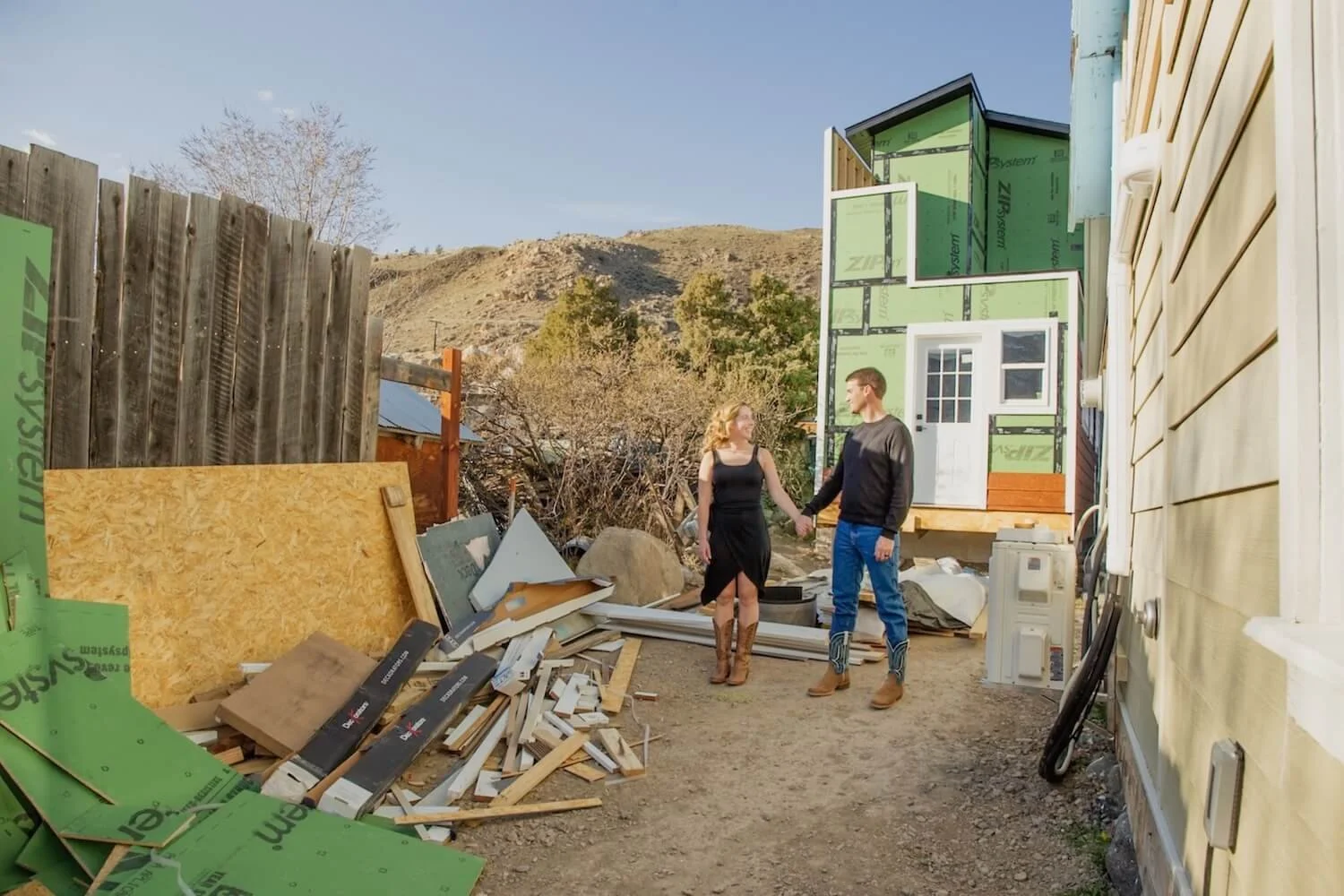
In the back left was the Unfinished Structure, a partially built shed that, according to the listing, was intended as a two-story apartment but had never been completed.

Property layout from the back: The Dry Cabin is on the left, while the Unfinished Structure is on the right. You can just see the top of the Yellowstone Cabin and, in front of that, the two-toned roof of the Main House.
Not Perfect, But Maybe Perfect for Us?
A property with this many possibilities? At this price point? This close to one of the most iconic national parks in the world? We were intrigued, but interest alone doesn’t buy a house, especially not one with this many unknowns and potential pitfalls. One of the biggest questions on our minds was: Could we really tackle this large a project?
Let me be clear: We’ve never done anything like this before.
We’re not fixer-uppers. No one’s asking to borrow our handyman skills. (Before this, we wouldn’t have said we had any.) The first home we bought was a new build. We had to select all the finishes and spend hours at a design center, but otherwise our involvement was minimal. We’d stop by the property every so often, check on the progress, and watch as a team of contractors handled everything else.
Our second home? A turnkey city condo that was move-in ready, no renovations required. We’ve never tiled a backsplash, replaced a light fixture, or demoed a wall. The biggest home project we’ve ever tackled (and I have to seriously think about this) has been putting together furniture. (Does that count?) Yet now, here we are, surrounded by massive projects in every direction, staring at a property that needs work everywhere we look.
Despite this, thanks to multiple structures, walkability to town, and the proximity to Yellowstone, we can’t help but see a lot of potential.
This property was located in Gardiner, Montana, less than one mile from the North Entrance to Yellowstone National Park. Regardless of its odds and ends, it checked more boxes than anything we’d seen in our two-and-a-half years of searching.
📍 Near a major outdoor attraction → Check.
🏡 Multiple rentable structures → Check.
🚶♂️ Walkability to shops, restaurants, and a grocery store → Check.
🌲 A year-round destination with multiple seasons of tourism → Check.
🛠️ A place we could put our own touch on → Check, check, check.
And the biggest surprise that totally charmed our socks off? The historic Yellowstone Cabin. It was a small, weathered structure that looked straight out of the park itself, and we knew, with some restoration, it could become something really special.
So, as we stood there taking it all in, I turned to Jonathan and said, “I can’t believe I’m saying this, but I think I like it.”
The Main House: A House Stuck in the Middle of a Renovation
The listing photos had set some expectations. We knew the interior hadn’t been updated and that the house had an unfinished addition, but the question was: How bad was it really?
When Jonathan unlocked the back door of the main house, and we stepped inside, our initial impression was that the house had been halfway renovated and abandoned mid-project. Everywhere we looked, we saw signs of unfinished work.
The main living space had fresh floorboards, but baseboards were missing, and transition strips weren’t installed. Layers of paint covered what were once holes or damaged drywall, but the patch jobs were obvious. Some doors had doorknobs barely hanging on, and in a few places, we could see straight through holes in the walls where plumbing had been accessed and never properly covered up.
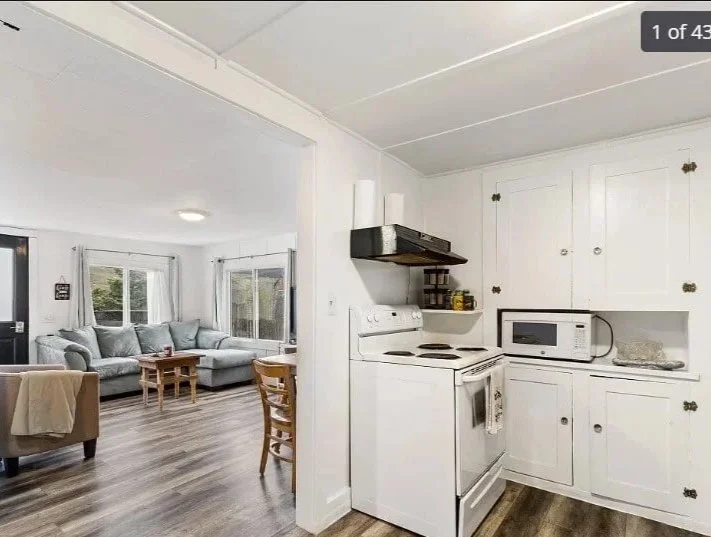
The kitchen was functional but outdated. The cabinets didn’t close, seemingly due to years of repainted surfaces. The countertops had been replaced at some point, but they didn’t match the rest of the space. It was a kitchen that worked, but it needed a lot of love.
The primary bedroom was small but had decent natural light. The second bedroom was even smaller and had the same unfinished edges as the rest of the house, including missing baseboards or trim and signs of quick, cheap patchwork repairs.
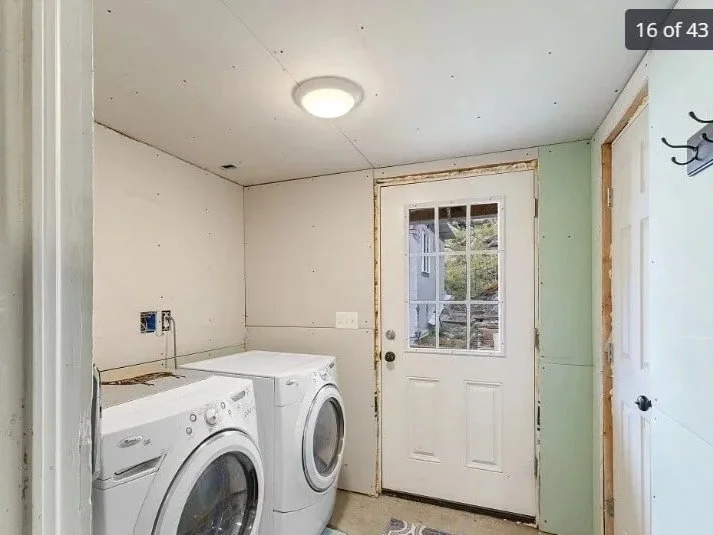
The biggest project of all was back in the first room we entered, the mudroom off the back door. At some point, the previous owners added a second bathroom and a laundry room as an extension at the back of the house, but had never finished the addition. There was no paint; the flooring was only partially complete; outlet covers were missing; etc.
Plus, the unfinished state of the extension wasn’t the only issue. The way they had set up this new bathroom was strange. It had been built with an exterior door, with the idea that the dry cabin, having no bathroom of its own, would use the second bathroom in the main house.
It didn’t take long to realize that the main house needed more than just a cosmetic touch. Many rooms needed an entire renovation. It was old, outdated, and worn down, with all the quirks you’d expect from a house built in the 1930s.
The Dry Cabin: A Rental-Ready Gem With One Big Problem
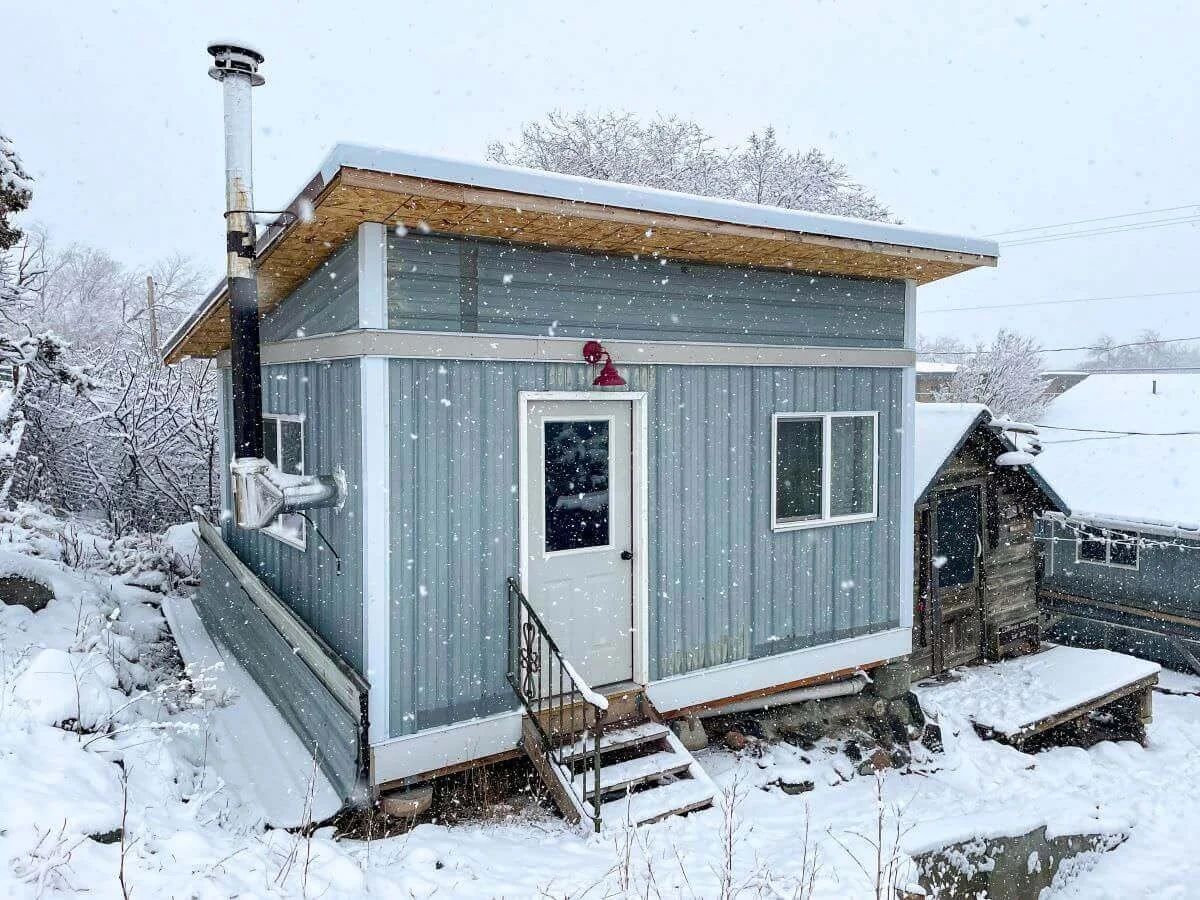
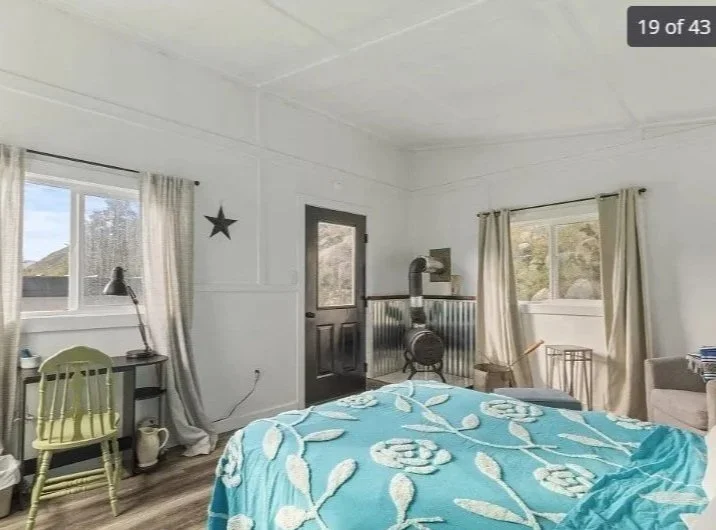
When we left the main house, we followed the dirt steps past the ranger hut and arrived at the Dry Cabin. It was a completely different feel from the main house, much lighter, more modern, and a space we both felt at home in immediately.
It was built within the last few years and featured beautiful finishes, high ceilings, and a clean, contemporary feel, making it surprisingly spacious despite its small footprint. If you ignored the fact that it lacked water, it was move-in ready.
But that was the big issue: this beautiful cabin didn’t have plumbing.
No bathroom. No running water. No kitchen or kitchenette. The previous owners had designed it as a true dry cabin, with guests walking outside to use the second bathroom in the main house.
If we bought the property, we’d have a decision to make. Do we leave it as a dry cabin, embracing the “glamping” experience? Or do we find a way to add plumbing and transform it into a fully functional unit?
Either way, we loved this cabin. Despite its limitations, we saw even more potential.
The Yellowstone Cabin: The Former Ranger Hut
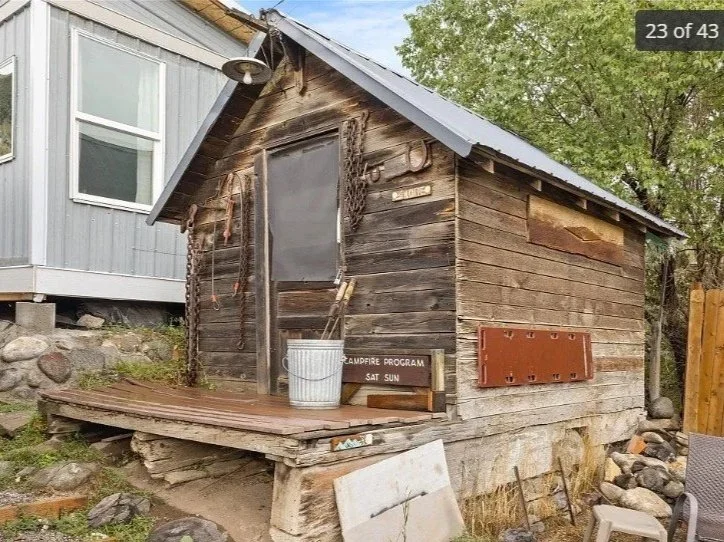
In between the Main House and the Dry Cabin sat the smallest structure on the property, what we’re calling The Yellowstone Cabin.
According to the listing, this rustic building was formerly a working ranger hut inside Yellowstone National Park and was relocated to the property years ago, bringing a piece of the park with it. The classic park signage, the weathered wood, and the undeniable historic charm made it feel like it belonged in Yellowstone, and we loved it.
At the moment, it was nothing more than a storage space, packed to the brim with tools and building materials. We had no idea what we’d use it for, but we knew it had the potential to be something very, very cool.
The Unfinished Apartment: The Wild Card
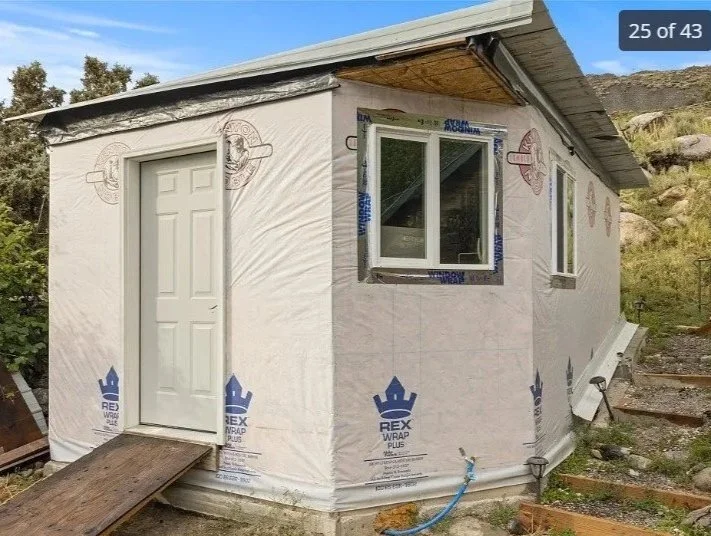
The fourth and final structure on the property was, by far, the most unfinished of them all. At present, it was being used as another shed, originally intended to become a two-story apartment, but it was nowhere near completion.
It, too, had potential, but it was easily the most ambitious project. With zero construction experience ourselves, we figured this would be something we tackled later, if at all. But at least there was something started, with plumbing stubbed in, ready to be tied to sewer and water, right? (Famous. last. words.)
A dream deal or a money pit?
By this point, we’d seen everything, and even with all its flaws, this property checked nearly every box we had been searching for. The location was perfect. The multiple structures fit our vision. The price was lower than anything comparable in town. But the work required? A lot.
As we stood there, going over what we had just seen, we both were wondering the same thing. This is a huge project, but is it also exactly what we’ve been looking for?
This house didn’t just check all of our practical boxes. It checked a deeper box we hadn’t even put into words yet. It was a chance to create something from the ground up. A project we could put our own stamp on. A challenge that would push us outside our comfort zone.
This was not going to be a simple, turnkey rental purchase. This was a fixer-upper, through and through. We would have to renovate the kitchen of the main house. There was a lot of foundational work to be done and many surface-level cosmetic fixes to be addressed. We would have to finish the second bathroom and laundry room, and decide what to do with the dry cabin. Then we’d need to decide whether the unfinished studio was worth completing and what to do with the historic shed.
And yet, we didn’t feel (entirely) overwhelmed. We had been searching for a property for over two and a half years, and this was the first one that truly fit our vision.
We locked up, got back in our car, and officially left town with more questions than answers, but also with a feeling we hadn’t had with any other place. We could see this working.
Although we were excited, there were legitimate questions to answer before jumping in with both feet. What’s the real condition of the house? How much work would it actually take to make it rental-ready? What are the risks of buying a fixer-upper in a remote small town like Gardiner?
Before making a decision, we needed to call in the experts.
Keep reading… (#3) Cabin Chronicles: The Good, The Bad & The Inspection Report
Related Posts