
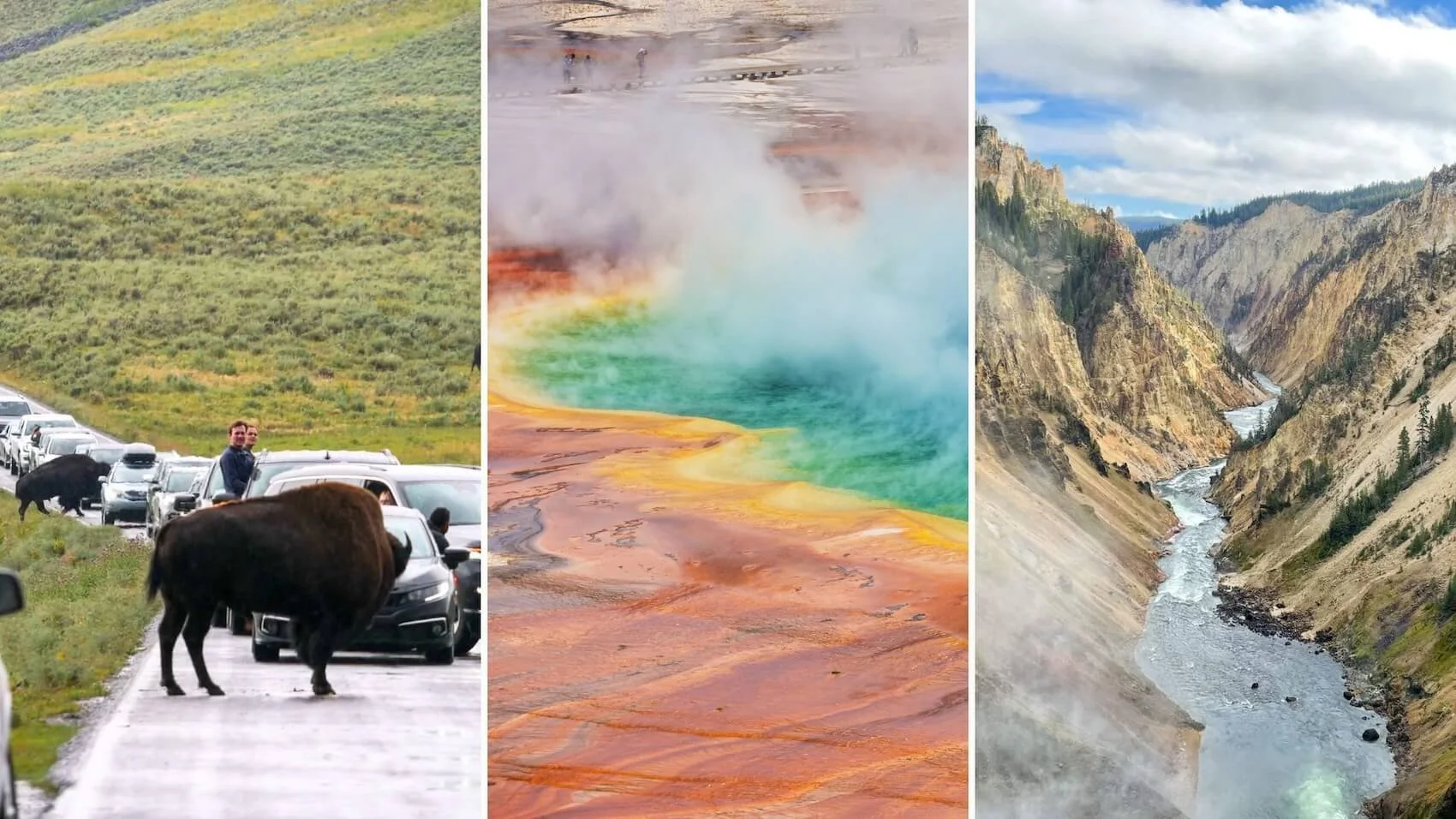
July is when Yellowstone is fully open, fully accessible, and fully in demand. Every road is open, high-elevation trails are accessible, and you can experience the entire park without working around seasonal closures. It’s one of the easiest times to see everything in one trip, which is exactly why so many people visit this time of year.
We’ve spent a lot of time in Yellowstone in peak summer, and while July is the busiest month in the park, it’s also one of the most straightforward to plan. You don’t have to think about limited access; you just have to plan your days a little differently. That’s the tradeoff.
July brings more access, more flexibility, and more to do, but also more people trying to experience the same places at the same time. If you understand what July actually looks like and how to plan around it, it’s one of the most complete Yellowstone experiences you can have.
Table of Contents
👋 Meet Your Guides: We're Jonathan and Kelly, and we love Yellowstone National Park. So much so that we've been a dozen+ times, bought fixer-upper cabins outside Yellowstone’s North Entrance, and turned an old park ranger hut into year-round Christmas magic. Now, we’re on a mission to make Yellowstone simpler and more magical for everyone who visits!
Want our best Yellowstone tips in one place? Check out our Yellowstone Travel Guide, packed with maps, itineraries, and everything you need to explore year-round.
What to Expect in Yellowstone in July
July is one of the most straightforward months to plan a Yellowstone trip because there are no major unknowns. Every road is open, every major area is accessible, and all park services (lodging, dining, stores, and tours) are fully operating. You don’t have to check opening dates or adjust your route around closures. You can build your itinerary around what you actually want to see, not what’s available.
The weather makes that easier, too. Daytime temperatures typically fall between the mid-60s and mid-80s, and while mornings and evenings can still be cool, it’s one of the few months where you can comfortably spend a full day outside without constantly adjusting your layers. July is also one of the drier months in the park, though it’s still common to see quick afternoon thunderstorms roll through, especially in higher elevation areas.
Wildlife is still a big part of the experience in July, but where to go is a little different than earlier in the season. You can still see bison, elk, wolves, bears, and more, especially in places like Lamar Valley and Hayden Valley. But as temperatures rise, many animals move toward higher elevations or stay closer to forest cover during the middle of the day. Sightings tend to happen earlier in the morning or later in the evening, and they’re usually a little less concentrated than they are in May and early June. You’ll also still see young animals across the park, but they’re growing quickly by this point and blending more into the landscape.
By the end of July, the bison rut begins! This is when bulls compete for mates, and it’s one of the more intense wildlife experiences you can see in the park. They’re more vocal, more active, and more unpredictable. You’ll hear deep bellows echoing across the valley, and it’s not unusual to get caught in a bison jam as herds move through the road. It’s an incredible thing to witness, but it’s also a time to be especially aware and keep your distance.
The other thing you’ll notice in July is how early the day starts. Parking lots at major stops like Old Faithful, Grand Prismatic Spring, and the Grand Canyon of the Yellowstone begin filling by mid-morning. Roads are busy, especially in the middle of the day, and drives take longer than they look on a map once you factor in traffic and wildlife. That doesn’t mean you won’t be able to see these places, but it does mean timing matters more than it does in other months.
One unexpected upside to July is how good it is for hiking. Trails are open, conditions are generally dry, and long daylight hours give you more flexibility. And while Yellowstone is busy overall, having more people on the trails isn’t necessarily a bad thing in bear country. It’s one of the reasons summer is actually one of the more comfortable times to get out and hike here. You’ll still want to start early for parking at popular trailheads, but once you’re out there, it’s one of the best ways to experience the park in July.

Why July Is One of the Best Times to Visit Yellowstone
July is busy, but there’s a reason for it. This is when Yellowstone is at its most complete. You have full access to every part of the park, including higher elevation areas like Dunraven Pass and Mount Washburn that aren’t reliably accessible earlier in the season. If hiking is important to your trip, this is one of the best months to be here.
Trail conditions are generally dry, snow is gone from higher elevations, and long daylight hours give you flexibility to spread your days out instead of rushing.
Wildflowers peak in July, especially in higher elevation meadows and along roads like Dunraven Pass. If you’re driving between Canyon and Tower, this is one of the best stretches to see them.
Yellowstone Lake is also fully in season. Boating, kayaking, and guided tours are all running. If your goal is to experience everything Yellowstone offers in one trip, July makes that possible.
When July Might Not Be the Best Fit
July isn’t the best fit if your goal is to have the park to yourself. Midday at major attractions is busy. Parking lots fill, boardwalks are crowded, and traffic slows down around popular areas.
It’s also not the easiest month to visit without a plan. If you show up late in the morning and move from one major stop to the next, the day can feel slow and a little frustrating. You’ll spend more time waiting, circling for parking, and working around crowds than actually enjoying each attraction.
But that’s not a reason to avoid July. It just means you need to approach the day a little differently. Here are our top suggestions for avoiding crowds in Yellowstone (even in July).
Driving the Grand Loop in July
Driving the Grand Loop is how most people experience Yellowstone for the first time. It connects all the major areas of the park—Mammoth, Tower, Canyon, Old Faithful, Yellowstone Lake—and on paper, it looks straightforward. What that map doesn’t show is how long everything takes once you’re there, especially in July.
Distances in Yellowstone are longer than they seem, and traffic adds time to everything. A drive that looks like it should take an hour can easily take two once you factor in slow traffic, wildlife sightings, and time spent finding parking at major stops. That’s the part most people don’t plan for when visiting in July.
While you can drive the entire loop in one day (even in peak summer), this will be a long, rushed day in the car. You’ll spend more time moving between places than actually enjoying them. A better approach is to break the park into sections.
Spend one day focusing on the northern half, including Mammoth, Lamar Valley, Tower, and the Grand Canyon of the Yellowstone. Then spend another day exploring the geyser basins, including Old Faithful and Grand Prismatic Spring. You’ll still see the same places, but it feels completely different when you’re not trying to do everything at once.
Timing also matters in July. Midday is when roads are busiest and parking is hardest to find, especially at places like Old Faithful, Grand Prismatic, and Artist Point. Early mornings and evenings are noticeably easier to navigate and often a better experience overall.
If you want a quieter drive, some of the best stretches of road are just beyond the main loop. The drive from Tower to the Northeast Entrance and the road out toward the East Entrance tend to see less traffic and still offer incredible scenery and wildlife potential.
If you’re planning to drive the full loop or map out your days in detail, we break it down step-by-step in our Grand Loop guide.

How crowded is Yellowstone in July?
July is the busiest month in Yellowstone.
You’ll feel it in the parking lots, on the roads, and at the park’s most popular stops like Old Faithful, Grand Prismatic Spring, and the Grand Canyon of the Yellowstone. By mid-morning, a lot of the main areas are already full, and moving through the park takes longer than it looks on a map.
But that’s only part of the picture. The weather is warm and consistent, you have long daylight hours to work with, and the entire park is open and easy to access. You can go anywhere, do anything, and see everything in one trip without working around seasonal closures.
This is also when Yellowstone looks its best in a lot of ways. Grand Prismatic is at its most vibrant on warm, calm afternoons, and wildflowers are in full bloom across the park, especially in higher elevation areas like Dunraven Pass.
Toward the end of the month, the bison rut begins in Lamar Valley, which adds a completely different kind of energy to the park.
So yes, July is crowded. But it’s also one of the most immersive Yellowstone experiences you can have.
If you want to understand how to plan around peak season, we break it down in detail in our guide for How to Avoid Crowds in Yellowstone (Without Missing the Best Spots). And if you’re deciding whether summer is worth it for you, we share our perspective in 7 Reasons Yellowstone in Summer Is Worth the Crowds.
What to Prioritize in Yellowstone in July
July gives you access to everything in Yellowstone, but how you spend your time makes a big difference in how your trip actually feels.
Hiking is one of the biggest advantages this time of year. High-elevation trails are open, conditions are generally dry, and you have long daylight hours to work with. If you want to get away from the busiest areas of the park, getting out on a trail is one of the easiest ways to do it. Even a short hike away from a main parking area can feel completely different from the boardwalk crowds.
If you’re planning to hike popular trails, it’s worth getting there early while parking is still easy. For shorter or less-trafficked hikes, heading out later in the afternoon can actually work in your favor once most people have started to wrap up their day.
July is also one of the best times to get on the water. Yellowstone Lake is fully in season, and you can go boating, kayaking, paddleboarding, or on a guided tour. Outside the park, rafting the Yellowstone River in Gardiner is another great option.
Remember: While the major attractions don’t change in July, how you approach them does. Planning ahead and giving yourself more time makes a noticeable difference. Booking lodging and activities early gives you more options, and staying longer allows you to spread your days out so you’re not trying to fit everything into a single, packed itinerary. If you want to see Yellowstone without feeling rushed, this is one of the most important adjustments you can make.
What Wildlife Can You See in Yellowstone in July?
Wildlife is still a big part of visiting Yellowstone in July. With longer daylight hours, you have more time to be out in the park, but the best viewing windows are still early morning and evening. During the middle of the day, many animals move toward higher elevations or stay closer to forest cover to avoid the heat, which makes them harder to spot.
If you’re out at the right times, though, there’s still a lot to see. Bison, elk, wolves, bears, pronghorn, and more are all active in July, especially in places like Lamar Valley and Hayden Valley.
One of the more interesting things to look for in July is wolf activity in Lamar and Hayden Valley. By mid-summer, wolf packs often settle into a consistent area for their pups, like a daycare for the pups while one or two adults remain nearby. These areas can sometimes be spotted from a distance with scopes, depending on where the pack has settled that year. Locations change, but once a pack establishes a site, they tend to stay in that general area for a while. If you’re interested in seeing wolves, it’s worth asking a ranger where recent activity has been.
Yellowstone Lake is also a good place to look for wildlife this time of year, especially river otters. They’re often seen swimming, fishing, or resting along the shoreline, particularly in the early morning or late afternoon when the lake is quieter. It’s one of the more relaxed wildlife experiences in the park and feels completely different from the valley viewing areas.
Bird activity is strong in July as well. Warblers, tanagers, and flycatchers are active in forested areas and meadows, while ospreys and bald eagles are commonly seen near rivers and lakes. If you’re near water, it’s always worth scanning the tops of nearby trees or along the shoreline.
Toward the end of July, the bison rut begins. Bulls become more active and more vocal as they compete for mates. You’ll hear deep bellows across the valley, and it’s not unusual to come across bison blocking the road as herds move through. Lamar Valley is one of the best places to witness this, but it’s also when it’s most important to give wildlife plenty of space.
Grizzly bears are still around in July, but you’re less likely to see them in the open valleys than you are in the spring. As the season progresses, they tend to move toward higher elevation areas to forage. Places like Dunraven Pass and the slopes around Mount Washburn are worth watching if you’re hoping to spot one.
No matter what you’re hoping to see, the basics still matter. Keep your distance, stay aware of your surroundings, and bring binoculars or a spotting scope if you have them. Wildlife in July takes a little more patience, but if you’re out at the right times and looking in the right places, it’s still one of the highlights of being in the park.

Otters on Yellowstone Lake near West Thumb Geyser Basin
Experiences That Are Especially Great in July
July gives you full access to the park, but a few experiences stand out this time of year. For example, one of the best ways to see Grand Prismatic Spring in July is from above.
The overlook on the Fairy Falls Trail is at its best on warm, calm afternoons, when the colors are at their most vibrant and the steam isn’t blowing across the spring. Earlier in the day, the view can look washed out or obscured, but on a hot summer afternoon, this is when it really shows up the way you’ve probably seen it in photos.
Just outside the park, this is also one of the best times to drive the Beartooth Highway. Because of its elevation, it’s typically only open from late spring through early fall, and even then, conditions can vary. By July, the road is fully open and clear, and it’s one of the most scenic drives in the country. If you’re entering or exiting through the Northeast Entrance near Cooke City, it’s absolutely worth the detour toward Red Lodge.
And toward the end of July, this is when the bison rut begins in places like Lamar Valley. Sometimes you don’t just see it, but actually end up in the middle of it. Traffic comes to a stop, and suddenly you’re surrounded. A 2,000-pound bull is blocking your path, with the rest of the herd lingering to your left and right. For a few minutes, you’re not just passing through Yellowstone. You’re in it, waiting for the herd to decide when you can move again.
The bison rut is one of the most intense and memorable experiences you can have in the park, and something you’re far more likely to encounter as July turns into August.
Keep reading: 10 Best Things To Do in Yellowstone Year-Round

Bison jam in Lamar Valley
FAQ: Yellowstone in July
What should I pack for Yellowstone in July?
Days are warm, but mornings and evenings can be cool, especially at higher elevations. We always bring a few lighter layers for daytime and something warmer like a fleece or light jacket for early starts and evenings.
Afternoon thunderstorms are possible, so having a rain layer is worth it, even if you don’t use it every day. Comfortable walking or hiking shoes are a must, especially if you plan to spend time on the trails.
If wildlife is high on your list, don’t skip binoculars. It’s one of the easiest ways to make your experience better.
We break this down in detail in our Yellowstone Packing List, including exactly what we bring and use.
Where should I stay for a July trip to Yellowstone?
If wildlife is a priority, staying near the North Entrance in Gardiner, Mammoth, or Tower makes it much easier to access Lamar Valley and the Northern Range early and late in the day.
If your trip is more focused on geysers and first-time sightseeing, areas like West Yellowstone, Old Faithful, or Canyon Village can work well for central access. Just know those areas tend to be busier and come with more traffic during the day.
If you have enough time, splitting your stay can make a big difference. A few nights near the geyser basins and a few near the Northern Range gives you a much more balanced experience.
We break this down in our full guide on where to stay in Yellowstone so you can choose the right area before booking.

How do you get to Yellowstone in July?
July is one of the easiest times to get to Yellowstone. All park entrances are open, and you don’t have to think about seasonal closures or road restrictions. Most people fly into Bozeman, Jackson Hole, or West Yellowstone, depending on where they’re staying. From Bozeman, it’s about a 1.5-hour drive to either the North or West Entrance.
Our guide on How to Get to Yellowstone: Airports, Entrances, and Rental Cars walks through the best routes, airports, and what to expect depending on where you’re coming from.
Is July the best time to visit Yellowstone?
July is a fantastic time to visit Yellowstone if you want to experience warm weather, all park facilities open, long daylight hours, and abundant wildlife, though it’s also the busiest month. Despite the crowds, July is a great time to experience everything Yellowstone has to offer in one trip.
Is July too crowded to visit Yellowstone?
July is busy, especially midday, but it’s still one of the best times to visit. With the right approach, it doesn’t have to define your experience.
What’s the weather actually like in Yellowstone in July?
July brings some of the most reliable weather of the year.
Daytime temperatures typically range from the mid-60s to mid-80s, while mornings and evenings can still drop into the 30s and 40s, especially at higher elevations. We learned this the hard way on our first trip when we camped in July and weren’t expecting how cold it would get. It dropped into the 30s overnight. It doesn’t always get that cold, but it’s worth checking the forecast as your trip gets closer and packing an extra layer or two just in case.
It’s also one of the drier months in the park, though short afternoon thunderstorms are still common, especially in higher elevation areas.
Can you swim in Yellowstone in July?
Yellowstone offers limited opportunities to swim or soak due to cold lake temperatures and boiling hot springs. The Firehole Swim Area, located two miles south of Madison Junction on Firehole Canyon Drive, is the only place to swim inside the park and generally opens for swimming mid-summer. (Note: Swimming is currently not allowed at Boiling River, as this area was impacted during the 2022 floods.)
Outside the park, you can swim and soak at Yellowstone Hot Springs, located about 12 minutes north of Gardiner, MT, and Chico Hot Springs, located about 40 minutes north of Gardiner.
Are there any road closures in Yellowstone in July?
Typically, all roads in Yellowstone are open in July, but temporary closures can occur due to weather or construction. Check current road status and conditions here.
What’s the best time of day to visit popular spots like Old Faithful in July?
Early morning or late evening are the best times to visit Old Faithful and other popular spots to avoid the heaviest crowds. Be at these areas before 9AM or after 5PM. In July, finding parking just about anywhere at midday will be challenging, so we recommend being on a trail or driving to more remote areas of the park this time of day.
Can I fish in Yellowstone in July?
July and August are generally the best months to visit Yellowstone for fishing. Most of the park's rivers and lakes are fully accessible, and fish feed actively due to the warm temperatures and high insect activity.
How many days do you need for Yellowstone in July?
For most people, 3 to 5 days is a great amount of time. That gives you enough flexibility to break up the Grand Loop, spend time on wildlife viewing, and explore geyser basins without rushing. If you only have 2 days, you can still see a lot, but you’ll need to be more intentional with your plan.
We map out realistic day-by-day options inside our Yellowstone Travel Guide, so you’re not trying to piece it together last minute.
What’s the best way to see Yellowstone in July if you only have a few days?
If you only have a few days in Yellowstone, focus on driving Grand Loop Road, visiting popular attractions like Old Faithful and the Grand Canyon of the Yellowstone, and looking for wildlife in Lamar and Hayden Valleys. Our Yellowstone Travel Guide has detailed 1 and 2-day Yellowstone itineraries.
Save this for later
Hover over the image below and click on the red “Save” button in the upper lefthand corner of the image to save this on Pinterest for later. (If you’re on mobile, you might have to tap the image first to see the red ‘Save’ button.)
Happy Travels!

More on Yellowstone
🏡 Staying Near the North Entrance? Explore the Cozy Yellowstone Compound in Gardiner, our small collection of cabins just minutes from the park gate.
🧳 Not Sure What to Pack? Check out our detailed Yellowstone Packing List, so you’re prepared for summer heat, shoulder-season cold snaps, or full winter conditions.
🦬 Still in Planning Mode? Browse all of our Yellowstone blog posts for wildlife guides, seasonal breakdowns, scenic drives, and practical tips from years of visiting Yellowstone.
📚 Want a Step-by-Step Plan? Our All-Seasons Yellowstone Travel Guide walks you through where to stay, how to structure your days, and what to expect in every month of the year.