
Yellowstone’s North vs West Entrance: Which Is Better?
One of the biggest Yellowstone planning decisions is choosing where to stay. When staying outside the park, that decision often comes down to staying in Gardiner, MT, near Yellowstone’s North Entrance, or West Yellowstone, MT, near the West Entrance.
Both entrances work well, but they create different Yellowstone trips by providing easy access to different parts of the park.
For example, the West Entrance is closest to Yellowstone’s major geyser basins and geothermal attractions like Old Faithful, Grand Prismatic Spring, and the Lower Loop. The North Entrance is closest to Yellowstone’s best wildlife corridors and provides easy access to Mammoth Hot Springs, the Northern Range, and Lamar Valley.
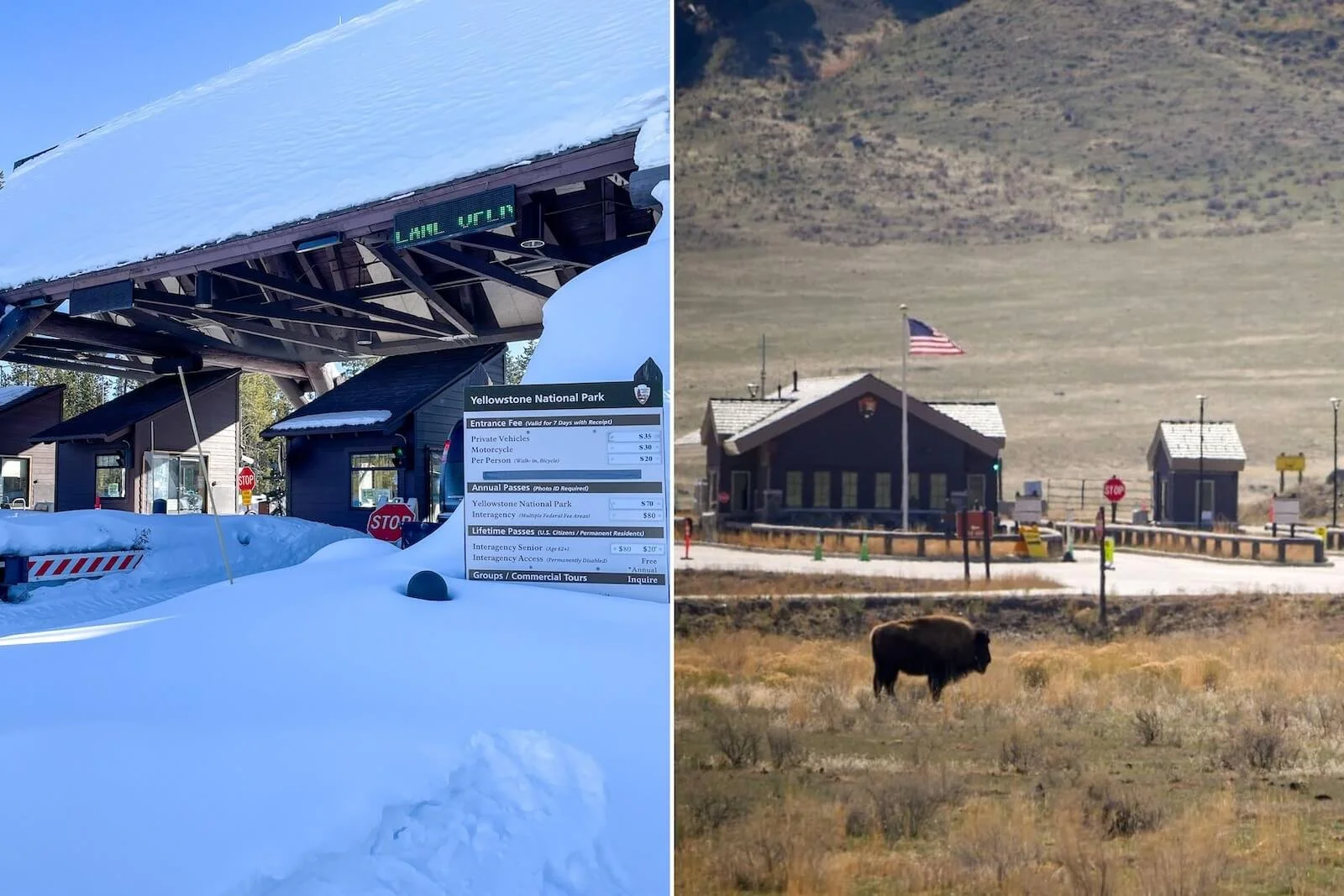
👋 Meet Your Guides: We're Jonathan and Kelly, and we love Yellowstone National Park. So much so that we've been a dozen+ times, bought fixer-upper cabins outside Yellowstone’s North Entrance, and are turning an old park ranger hut into year-round Christmas magic. Now, we’re on a mission to make Yellowstone simpler and more magical for everyone who visits!
📚 Want our best Yellowstone tips in one place? Check out our Yellowstone Travel Guide, packed with maps, itineraries, and everything you need to explore year-round.
🏡 Visiting Yellowstone’s North Entrance? Explore the Cozy Yellowstone Compound in Gardiner, our small collection of cabins near Yellowstone’s only year-round entrance.
Yellowstone’s West Entrance
The West Entrance is the busiest entrance in Yellowstone during summer and one of the most popular choices for first-time visitors.
Part of that is geography. For those driving from Idaho, Utah, Nevada, or the Pacific Northwest, the West Entrance is often an easier approach into the park.
The other major reason is location. If your Yellowstone priorities are seeing geyser basins and thermal areas, like Old Faithful, Grand Prismatic Spring, Fountain Paint Pot, and Norris Geyser Basin, the West Entrance is the closest gateway town to stay in.
That proximity matters because Yellowstone driving adds up quickly throughout a trip. Staying near the West Entrance reduces the amount of repeated long driving days needed to reach the park’s main geothermal areas.
What it’s like staying in West Yellowstone
West Yellowstone is a slightly larger tourism town than Gardiner. There are more hotels, restaurants, shops, and lodging. For that reason, it’s generally the better entrance for many families. While Gardiner’s family-friendly activities are more recreation-based, such as whitewater rafting and horseback riding, West Yellowstone has more entertainment-based activities for kids. Some examples include the Grizzly & Wolf Discovery Center, the IMAX theater, and the Playmill Theatre in nearby Island Park.
We especially love the Grizzly & Wolf Discovery Center. You get to see grizzly bears and wolves (among many other animals) up close, which is a very different experience than spotting wildlife at a distance inside the park.
🎯 RTL Tip: If your Yellowstone trip is heavily focused on geothermal areas, we also strongly recommend staying inside the park at Old Faithful Village. Being able to walk to Old Faithful early in the morning or later in the evening without dealing with parking lots or traffic completely changes the experience.
Yellowstone’s North Entrance
The North Entrance is the only Yellowstone entrance open to cars year-round. This entrance provides easy access to Mammoth Hot Springs, Yellowstone’s Northern Range, Tower-Roosevelt, and Lamar Valley.
This is the side of Yellowstone most associated with wildlife watching, mountain scenery, recreation, photography, scenic driving, and winter access. The Northern Range is also the best overall wildlife watching area in all of Yellowstone National Park.
Wildlife sightings in this area often begin before visitors even enter the park. Elk regularly move through Gardiner itself, and once you pass through Roosevelt Arch, it’s common to see pronghorn, bison, elk, deer, and occasionally bears along the road.
As you continue east toward Tower-Roosevelt and Lamar Valley, wildlife opportunities increase even more. The area from Tower-Roosevelt to Tower Fall is especially good for black bear sightings in the spring, while Lamar Valley is one of the best areas in Yellowstone for bears and wolves.
What it’s like staying in Gardiner
Gardiner feels smaller and more connected to the landscape than West Yellowstone. The Yellowstone River runs directly through town. Mountains surround the valley. Wildlife moves through neighborhoods and properties. We regularly see elk and mule deer near our cabins, and we’ve also had foxes and bears on the property. It feels like the park extends into town.
The activities around Gardiner are recreation-heavy, making Gardiner feel like an adventure town. Instead of museums and tourism attractions, the North Entrance experience is more likely to involve wildlife watching, hiking, horseback riding, whitewater rafting, fishing, scenic driving, snowshoeing, and cross-country skiing.
Gardiner is generally one of the better Yellowstone gateway towns for visitors traveling with dogs because there is easy access to dog-friendly trails in surrounding national forests. (Dogs are not allowed on trails inside Yellowstone itself. Read next: Can You Bring Dogs to Yellowstone? A Complete Guide for Pet Owners)
Driving into the Park from the West vs. North Entrance
One thing people do not always realize before visiting Yellowstone is how different the drive into the park feels from these entrances.
From the West Entrance, much of the drive between West Yellowstone and Madison Junction is lined with dense lodgepole pine forest. You’re in Yellowstone, but for long stretches of the initial drive, you are mostly looking at trees on both sides of the road.
The North Entrance is the opposite. The Yellowstone River runs through the valley, mountains are visible in every direction, and the drive to Mammoth (and beyond) is generally open to wildlife habitat, mountain views, scenic pullouts, and open terrain.
If part of your Yellowstone trip is simply wanting to spend time driving through beautiful scenery and feeling like you are “in Yellowstone” the moment you enter the park, the North Entrance does that sooner.
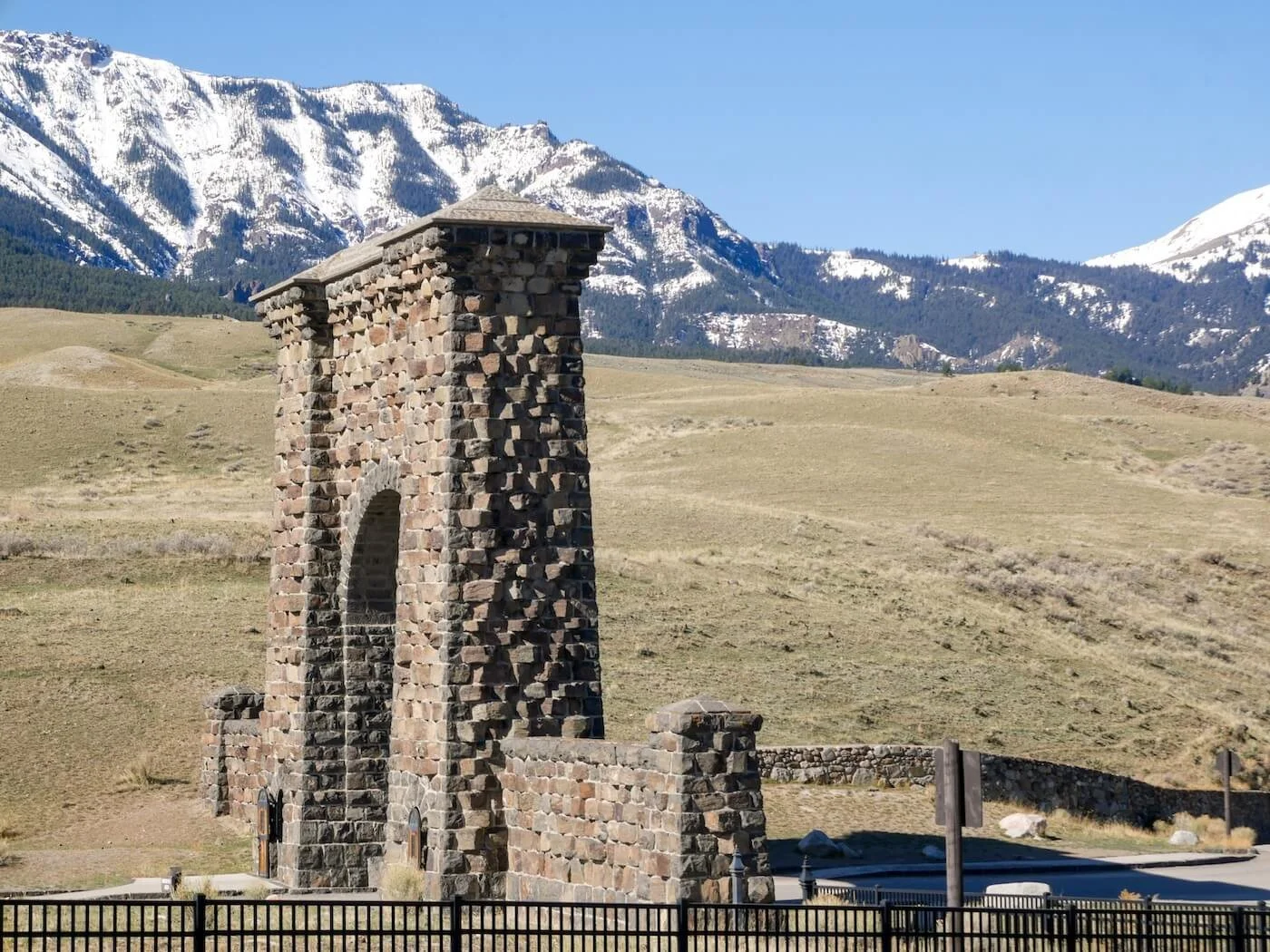
Roosevelt Arch, North Entrance
Is the North or West Entrance better in winter?
Winter access works differently between these entrances. If you want to self-drive Yellowstone in winter using your own vehicle or rental car, the North Entrance is the only option. From there, you can drive into Yellowstone to visit Mammoth Hot Springs, drive the Northern Range, and go wildlife watching, snowshoeing, and cross-country skiing without booking a tour.
The West Entrance is still open during winter, but it requires over-snow travel. That means you cannot drive into Yellowstone from the West Entrance in the winter, but you can book snowmobile and snowcoach tours to enter and explore the park.
If you’re wanting to snowmobile in Yellowstone, the West Entrance is your best option. That’s because snowmobile tours currently operate out of West Yellowstone only. (You can book snowcoach tours from either the West or North Entrances.)
Winter also changes the feel of the town of West Yellowstone itself. Snowmobiles ride through town like cars, and winter recreation and guided park access is operating at full capacity.
For the fullest winter in Yellowstone experience, we strongly recommend splitting your stay between both entrances. The North Entrance gives you the freedom to self-drive and explore the Northern Range independently, while the West Entrance gives you access to Yellowstone’s interior winter tours and snowmobile infrastructure.
Read Next: Yellowstone in Winter: What to Know Before You Go
Which entrance is better?
We think the North Entrance is better for wildlife watching and mountain scenery, while the West Entrance is better for access to Yellowstone’s geyser basins and thermal features. If you’re interested in recreation, Gardiner is better. If you’re looking for family-friendly entertainment, West Yellowstone is better.
For our Yellowstone trips, we personally spend more time at the North Entrance. The wildlife watching, Northern Range, recreation, scenic driving, and year-round access are what we enjoy most.
That said, we still regularly spend time around Old Faithful (often making the trip from Gardiner) and understand why many first-time visitors choose the West Entrance. They’re simply different parts of Yellowstone, and the best entrance depends on how you plan to spend your time.
If your Yellowstone priorities are geyser basins, geothermal attractions, the Lower Loop, and a larger tourism town, the West Entrance is usually the better fit.
If your priorities are wildlife watching, scenic driving, recreation, off-season access, and spending time along Yellowstone’s Northern Range, the North Entrance is usually the better fit.
For longer trips, a split stay is our recommendation for first-time visitors who want to see as much of the park as possible. Spend a few days along the Northern Range and a few days closer to Yellowstone’s Interior.
Read Next: Where to Stay in Yellowstone National Park
More on Yellowstone
🏡 Staying Near the North Entrance? Explore the Cozy Yellowstone Compound in Gardiner, our collection of cabins just minutes from the park gate.
🧳 Not Sure What to Pack? Check out our detailed Yellowstone Packing List, so you’re prepared for summer heat, winter cold, and everything in between.
🦬 Still in Planning Mode? Take our free Yellowstone Traveler Quiz to discover your travel style and get our free Yellowstone Planning Playbook.
📚 Want a Step-by-Step Plan with Customizable Itineraries? Our All-Seasons Yellowstone Travel Guide walks you through where to stay, how to structure your days, and what to expect in every month of the year.