
Driving times in Yellowstone are rarely just about mileage. Roads inside the park are slow, scenic, and often interrupted by wildlife, construction, weather, overlooks, and parking delays. A drive that looks simple on a map can easily become half-day trek once you start moving through the park.
The good news is, Yellowstone isn’t a place you want to rush through anyway. Some of the best parts of Yellowstone happen between destinations. A drive through Lamar Valley might turn into an hour spent watching wolves through spotting scopes, or a drive to Tower Fall may slow to a stop because of roadside elk, bison, or even bears.
We’ve spent years exploring Yellowstone in every season and now host guests at our Cozy Yellowstone Compound in Gardiner, Montana. This guide breaks down realistic drive times from the North Entrance to popular attractions, including Mammoth Hot Springs, Lamar Valley, Norris Geyser Basin, Old Faithful, Canyon Village, and more.
Table of Contents
👋 Meet Your Guides: We're Jonathan and Kelly, and we love Yellowstone National Park. So much so that we've been a dozen+ times, bought fixer-upper cabins outside Yellowstone’s North Entrance, and are turning an old park ranger hut into year-round Christmas magic. Now, we’re on a mission to make Yellowstone simpler and more magical for everyone who visits!
📚 Want our best Yellowstone tips in one place? Check out our Yellowstone Travel Guide, packed with maps, itineraries, and everything you need to explore year-round.
🏡 Visiting Yellowstone’s North Entrance? Explore the Cozy Yellowstone Compound in Gardiner, our small collection of cabins near Yellowstone’s only year-round entrance.
How to Plan Driving Times in Yellowstone
Yellowstone is a large national park. It spans more than 2 million acres, and most roads are two-lane mountain roads with relatively low speed limits. More than that, Yellowstone is a place that naturally slows people down.
Wildlife sightings happen constantly throughout the Northern Range, traffic jams form quickly around bears, bison, and elk, and road construction is common during the short summer season. These are just some of the reasons a drive that appears to be an hour on Google Maps might turn into a half-day once you add stops, scenic overlooks, and wildlife viewing.
As a rough rule, we estimate Yellowstone drive time by doubling the mileage, then adding extra buffer depending on the route, season, and time of day. (Less buffer time for shorter routes, more buffer time for longer routes.) A 20-mile drive may take close to an hour. A 50-mile drive could be a half-day outing. If you have a tour or reservation, give yourself additional buffer time just in case.
Note: If you’re trying to estimate driving times during Yellowstone’s Off-Season using Google Maps, make sure you switch “Leave now” to “Depart at” and pick a date after Memorial Day for the most accurate driving times.
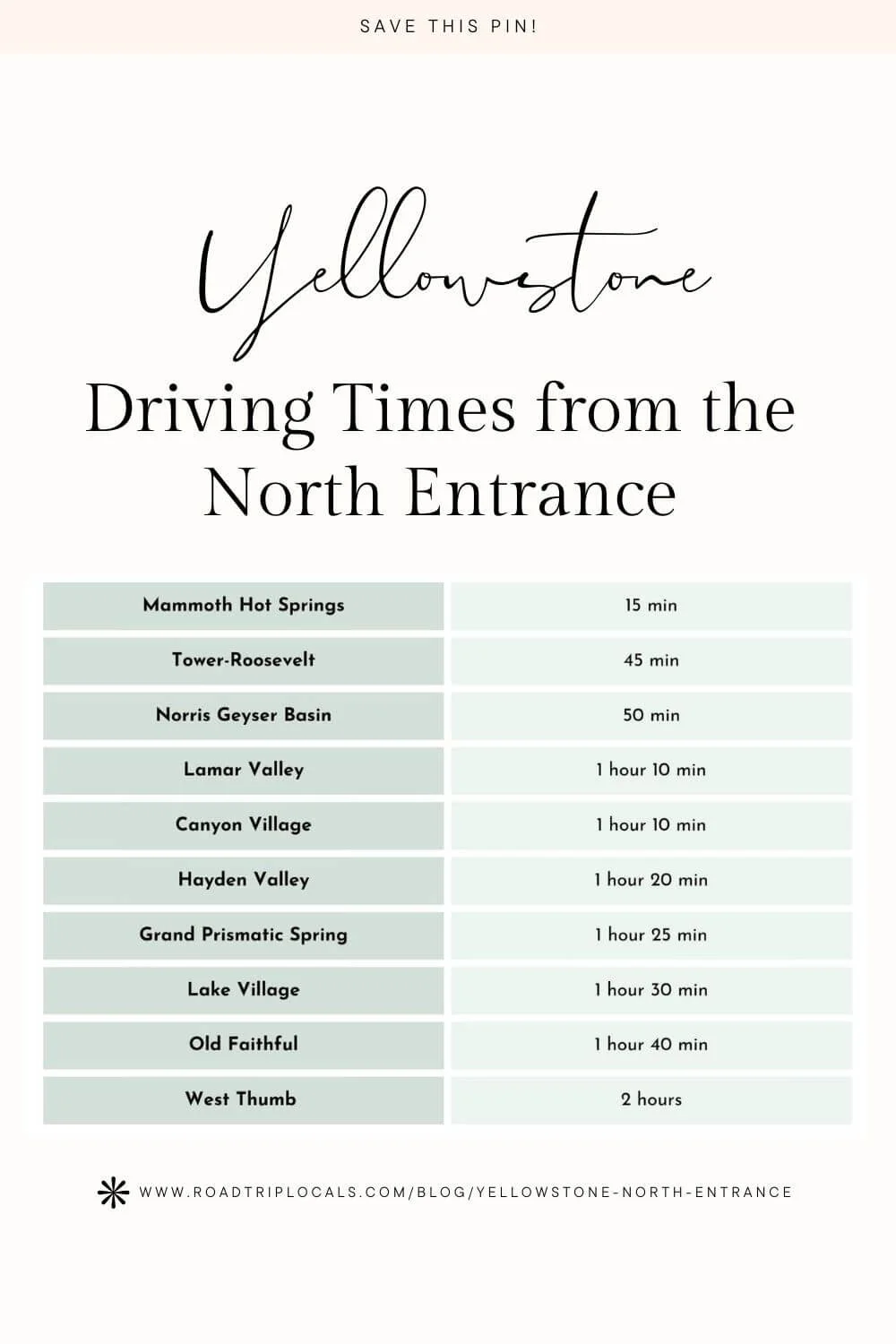
Here’s a starting point for driving times from Yellowstone’s North Entrance. (These are calculated without stops.)
North Entrance to Mammoth Hot Springs
Approximate Drive Time: 15 minutes
Mammoth Hot Springs is the first major attraction inside Yellowstone from the North Entrance. The drive itself is short, but don’t be surprised if you’re tempted to take your time. Elk, bison, and pronghorn are commonly seen between Gardiner and Mammoth, and there are many roadside pullouts available to stop, observe, and take photos.
Once you get to Mammoth, it’s easy to spend several hours exploring the Upper & Lower Terraces, Albright Visitor Center, general stores, and restaurants.
Read Next: Yellowstone In A Day: 1-Day Itinerary for First-Time Visitors
North Entrance to Tower-Roosevelt
Approximate Drive Time: 45 minutes to 1 hour
To get to the Tower-Roosevelt junction from Yellowstone’s North Entrance, you’ll turn left at Mammoth Hot Springs, drive through rolling hills near Blacktail Plateau, and continue east toward Tower Fall.
Wildlife sightings are common throughout this stretch, especially in spring and early summer when bears and baby animals are active along the road. Bison, elk, pronghorn, coyotes, and bears are all seen here, and wildlife traffic jams are part of the experience.
Tower-Roosevelt works well as both a destination with nearby Tower Fall, and as a transition point for visitors continuing toward Lamar Valley, Canyon Village, or Mount Washburn.
Read Next: Where to See Bears in Yellowstone Nat'l Park
North Entrance to Lamar Valley
Approximate Drive Time: 1 hour 15 minutes
Lamar Valley is one of the most famous wildlife-watching destinations in the world and a main reason visitors stay near the North Entrance.
Although reaching the heart of Lamar Valley takes over an hour, wildlife sightings usually begin much sooner. It’s common to see elk, bison, coyotes, foxes, bears, and even wolves along this drive through Yellowstone’s Northern Range.
Early mornings and evenings are generally the best times of day for wildlife activity in Lamar Valley. Many visitors spend several hours here scanning hillsides with binoculars and spotting scopes.
Read Next: 12 Best Places for Wildlife Viewing in Yellowstone
North Entrance to Cooke City
Approximate Drive Time: 2 hours
The drive from the North Entrance at Gardiner, MT, to the Northeast Entrance at Cooke City, MT, is one of the most scenic drives in Yellowstone. The route follows the entirety of Yellowstone’s Northern Range, through Mammoth, Tower-Roosevelt, and Lamar Valley.
Cooke City and neighboring Silver Gate are small mountain towns that feel much quieter and more remote than many other Yellowstone gateway areas. During summer, this route also connects to the Beartooth Highway, one of the most beautiful highways in the United States.
In winter, Cooke City becomes a snow-focused mountain town popular for snowmobiling and winter recreation.
Read Next: What Is Yellowstone’s Northern Range? Plan a Self-Guided Tour
North Entrance to Norris Geyser Basin
Approximate Drive Time: About 1 hour
The drive from Yellowstone’s North Entrance to Norris Geyser Basin passes through Mammoth Hot Springs before heading south.
The landscape changes quickly here, shifting from the open valleys and wildlife habitat of the Northern Range into thicker forest, winding mountain roads, and Yellowstone’s geothermal interior. There are several beautiful viewpoints along the drive, interesting rock formations near the road, and access to some great hikes between Mammoth and Norris.
Norris Geyser Basin itself is one of Yellowstone’s most active and unpredictable thermal areas. It’s also home to Steamboat Geyser, the tallest active geyser in the world.
North Entrance to Grand Prismatic Spring
Approximate Drive Time: About 1.5 hours
The Grand Prismatic Spring is one of Yellowstone’s most popular attractions, and it’s one of the longer day trips from the North Entrance. The route travels south through Mammoth and Norris before entering Yellowstone’s geothermal-focused western corridor.
From the North Entrance, Grand Prismatic usually makes the most sense as part of a full Lower Loop day, not a standalone drive. Pair it with Norris, Fountain Paint Pot, and Old Faithful, and build in extra time for parking at the Midway Geyser Basin.
Read Next: The 10 Best Things To Do in Yellowstone Year-Round
North Entrance to Old Faithful
Approximate Drive Time: About 1 hour 45 minutes
Old Faithful is reachable from the North Entrance, but we would not treat it like a quick there-and-back stop.
From Gardiner, this is usually a full-day outing, especially if you also want to see Norris Geyser Basin, the Grand Prismatic Spring, or any other geyser basins along the way.
Read Next: Yellowstone Lower Loop: Itinerary, Map, and 10 Best Stops
North Entrance to Canyon Village
Approximate Drive Time: About 1.5 hours via Norris | Longer via Dunraven Pass
From the North Entrance, most visitors reach Canyon by driving south through Mammoth Hot Springs and Norris Geyser Basin, then turning left to head east. This is typically the fastest and most reliable route, especially early and late in the season when Dunraven Pass is still closed.
That said, the drive through Tower-Roosevelt and Dunraven Pass is easily one of our favorite drives in Yellowstone when conditions allow. The road winds through high mountain terrain with huge views, alpine scenery, and access to hikes like Mount Washburn.
Because of that, we usually recommend turning this into a larger Upper Loop day rather than simply driving straight to Canyon and back. A route that combines Mammoth, Tower-Roosevelt, Dunraven Pass, and Canyon gives you a good feel for how varied this part of Yellowstone really is.
Read Next: Yellowstone Upper Loop: Best Stops for Views, Wildlife, and Hiking
North Entrance to West Thumb Geyser Basin
Approximate Drive Time: About 2 hours
West Thumb sits along the shoreline of Yellowstone Lake near the southern portion of the park. Because of the distance involved, West Thumb is worth seeing if you’re already building a Lower Loop day, but it is far enough from the North Entrance that we would not make it the only goal of the drive.
Read Next: Grand Loop Road: Map & Itinerary for Yellowstone’s Most Scenic Drive
North Entrance to Grand Teton National Park
Approximate Drive Time: About 3 hours
Many visitors combine Yellowstone and Grand Teton into the same trip. The North Entrance can still work for that kind of itinerary (we’ve done it); however, this is a long drive. You’ll travel south past Mammoth, Norris, Old Faithful, and West Thumb Geyser Basin before entering Grand Teton National Park.
If Grand Teton is a major priority for your trip, we recommend splitting your stay between multiple areas of the park (or parks) rather than driving from the North Entrance every day.
Read Next: Grand Teton Scenic Drive: 13 Best Stops for Views, Wildlife, and Hiking
What We Would Not Do From the North Entrance
You can see a lot of Yellowstone from the North Entrance. Driving the Grand Loop, including the Lower Loop, to see attractions like Old Faithful, the Grand Prismatic Spring, Hayden Valley, and Yellowstone Lake is completely doable during summer when daylight hours are longest. But those are full days—expect an early start, a later return, and a lot of driving.
What we would not do is structure every day that way. Instead of making repeated long drives to single attractions in different parts of the park, we recommend grouping areas together as much as possible.
For example, combine Old Faithful, the Grand Prismatic Spring, and Norris into one day rather than driving south to Grand Prismatic one day, back south again for Old Faithful the next, and then across the park to Canyon the following day.
From the North Entrance, Yellowstone usually works best when you balance the longer driving days with slower days focused on wildlife watching, hiking, Mammoth Hot Springs, the Northern Range, rafting, horseback riding, or simply spending more time outside the car. This is one of the reasons we created our Yellowstone Travel Guide.
Not just to highlight the best things to see and do in Yellowstone, but also to help you put the pieces together in a way that actually works. Inside, you'll find 1-day Yellowstone itineraries, multi-day Yellowstone itineraries, wildlife maps, seasonal advice, lodging recommendations, route suggestions, and everything else we've learned after years of visiting Yellowstone in every season, gathered together in one place.
We've already done the piecing together for you, so you can spend less time sorting through articles, videos, maps, and search results, and more time feeling excited about your trip! If you’re tired of wondering whether you’re missing something or feeling overwhelmed by all the moving pieces of Yellowstone planning, this is where we’d start.
👉 Get the Yellowstone Travel Guide
Tips for Planning Drive Days From Yellowstone’s North Entrance
Start earlier than you think you need to.
Allow extra time for wildlife traffic jams.
Don’t overpack your itinerary.
Expect summer construction delays.
Carry snacks and water.
Download offline maps before entering the park, and pick up a park brochure at any visitor center or entrance gate.
Plan longer drives as full-day outings.
Treat wildlife sightings as part of the experience, not interruptions.
More on Yellowstone
🏡 Staying Near the North Entrance? Explore the Cozy Yellowstone Compound in Gardiner, our collection of cabins just minutes from the park gate.
🧳 Not Sure What to Pack? Check out our detailed Yellowstone Packing List, so you’re prepared for summer heat, winter cold, and everything in between.
🦬 Still in Planning Mode? Take our free Yellowstone Traveler Quiz to discover your travel style and get our free Yellowstone Planning Playbook.
📚 Want a Step-by-Step Plan with Customizable Itineraries? Our All-Seasons Yellowstone Travel Guide walks you through where to stay, how to structure your days, and what to expect in every month of the year.